
Last updated: June 2026 | Reading time: 28 min
Which legal AI should you choose in 2026? The French market now counts around fifteen serious solutions, from century-old publishers (GenIA-L by Dalloz, Lamy) to sovereign pure players (Ordalie, Jimini) all the way to the American giants (Harvey, Lexis+ AI). We tested every available solution and cross-checked our results against data from the CNB — French National Bar Council (March 2025), the independent comparisons by Meta-Doctrinal, Pamplemousse Magazine and AvocatCity, as well as academic benchmarks on LLM hallucinations.
The numbers confirm how pressing the issue is. According to the CNB / Viavoice survey (March 2025), nearly one law firm in two has already tested a legal AI. The real question remains: which one, for what use, and at what level of confidentiality?
Methodology
All tests were carried out by legal and legaltech practitioners, in a controlled environment: identical queries, identical use cases (case-law research, drafting legal documents, contract analysis, litigation preparation). Our results were cross-checked against institutional data from the Conseil national des barreaux (French National Bar Council), the Paris Bar, and research on the reliability of legal LLMs (ActuIA, IA Focus Magazine). Prices were verified on publishers’ websites in May 2026. No affiliate links, no commercial partnerships: this review is independent.
Contents
- The 4-level data sovereignty grid
- Comparison table of the 16 solutions
- GenIA-L by Lefebvre Dalloz
- Lamyline New by Wolters Kluwer
- Doctrine
- Predictice
- Ordalie
- Jimini AI
- Haiku (formerly Clerk)
- Juri’Predis
- MCP Factory by Zevra
- Dairia IA
- International solutions
- Niche tools
- Which legal AI for which profile
- Summary matrix
- Verdict and tier list
- The hallucination problem
- The AI Act and legal AI in 2026
- Outlook at 1, 3 and 5 years
- FAQ
- Why open data is the future of legal AI
- Our testing methodology
The 4-level data sovereignty grid
For a lawyer, professional secrecy is not optional. The CNB’s AI working group points out that a simple “hosted in France” label is “neither sufficient nor verifiable.” So before even comparing features, you need to place each tool on a sovereignty scale. We propose a four-level grid, from the most protective to the riskiest.
| Level | Cumulative criteria | Cloud Act and reuse risk | Recommended use |
|---|---|---|---|
| 🟢 L1 sovereign | Hosting in FR or EU on infrastructure not subject to US law, encrypted data, not reused for training, FR or EU publisher | Near zero | Identifying client data, procedural documents |
| 🟡 L2 EU on US cloud | EU hosting but on Azure, AWS or GCP (American subsidiaries) | Residual (theoretical Cloud Act) | Pseudonymized data, research |
| 🟠 L3 extra-EU with safeguards | Hosting outside the EU with contractual guarantees (standard clauses, DPF) | Real but contractually framed | Monitoring, non-sensitive tasks |
| 🔴 L4 uncontrolled | General-purpose consumer LLM (ChatGPT, free Gemini) without a professional contract, data potentially reused | High | To be avoided for any client data |
Bottom line: a high-performing tool rated L3 or L4 can still be relevant for monitoring or work on public data. The problem starts the moment you feed it a named case document. The ethical rule takes precedence over functionality.
This grid draws on the work of the CNB’s AI group. For the official version of the criteria, see the CNB self-assessment grid.
Comparison table of the 16 solutions
Indicative prices excl. VAT, verified in May 2026 on publishers’ websites and compiled from our directory of 184 legaltechs. They may change and often depend on the number of users.
| Tool | Type | Indicative price | Hosting | Sovereignty |
|---|---|---|---|---|
| GenIA-L (Dalloz) | Assistant + editorial library | from ~€80/month, quote-based | France / EU | 🟢 L1 |
| Lamyline New (Wolters Kluwer) | Assistant + editorial library | from ~€132/month | Sweden (Azure) | 🟡 L2 |
| Doctrine | Case-law research | from €159/month (€1,392/year) | France | 🟢 L1 |
| Predictice | Predictive justice | quote-based (~€2,000/year) | France | 🟢 L1 |
| Ordalie | General-purpose assistant | €57 to €89/month | France | 🟢 L1 |
| Jimini AI | Assistant + automation | quote-based | France (ISO 27001 + HDS) | 🟢 L1 |
| Haiku (formerly Clerk) | Assistant on firm’s own library | quote-based | France / EU | 🟢 L1 |
| Juri’Predis | Research + monitoring | quote-based (15-day trial) | France | 🟢 L1 |
| MCP Factory (Zevra) | Open data infrastructure | open / API | France | 🟢 L1 |
| Dairia IA | Niche: employment law | from €90/month (7-day trial) | France | 🟢 L1 |
| Oro / Tomorro | Contracts (CLM) | quote-based | France / EU (ISO 27001) | 🟡 L2 |
| Lexbase | Research + publishing | quote-based | France | 🟢 L1 |
| Jus Mundi | International law, arbitration | quote-based | France | 🟡 L2 |
| Lexis+ AI (LexisNexis) | Assistant + global library | quote-based (high) | EU / US | 🟠 L3 |
| Harvey AI | Corporate law firms | ~$1,000 to $1,200/month | US | 🟠 L3 |
| Spellbook | Contract drafting (Word) | ~$100 to $200/month | US / Canada | 🟠 L3 |
GenIA-L by Lefebvre Dalloz
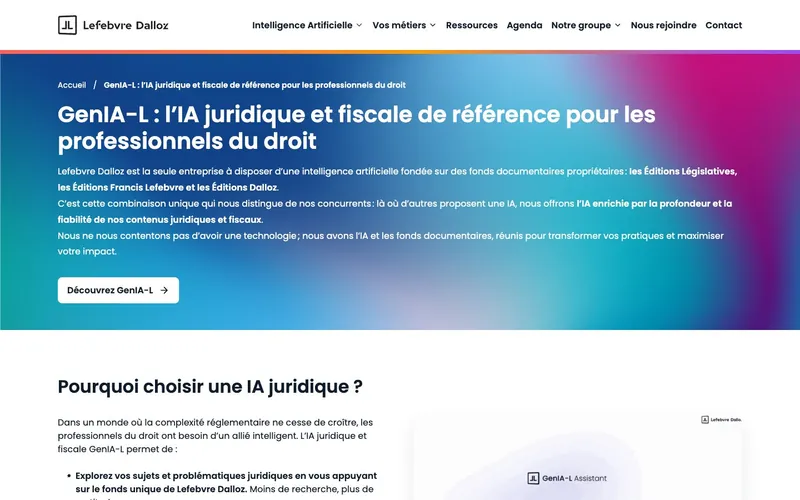
The most comprehensive editorial library on the French market. Sovereignty 🟢 L1. From ~€80/month, quote-based.
GenIA-L rests on a structural advantage that no one can easily replicate: the Dalloz, Francis Lefebvre and Éditions Législatives document libraries, updated daily. This is France’s century-old reference legal publisher. When you ask it a question, the tool doesn’t search the web: it draws on its own doctrine, its own annotated codes, its own annotated case law.
Strengths:
- Reliability rate of 92 to 93% in comparative tests, the highest on the French market
- Zero exposure to US law, no common-law contamination unlike general-purpose LLMs
- Source traceability: every answer links back to articles, decisions and doctrinal commentary
- Structured answers: summaries, practical cases, points to watch, reproducing legal reasoning
- Full sovereignty: encrypted data, not exploited, stored in Europe
Weaknesses:
- Opaque pricing on some plans, sometimes conditional on a pre-existing Dalloz subscription (source)
- Less automation than some competitors (no contract drafting, no predictive features)
Our take: GenIA-L’s strength is that the AI is merely an interface layer on top of an irreplaceable editorial library. Where others run RAG on open data (Légifrance, Judilibre), Dalloz has 200 years of proprietary doctrine. It’s the gap between Wikipedia and the Encyclopaedia Universalis.
Lamyline New by Wolters Kluwer
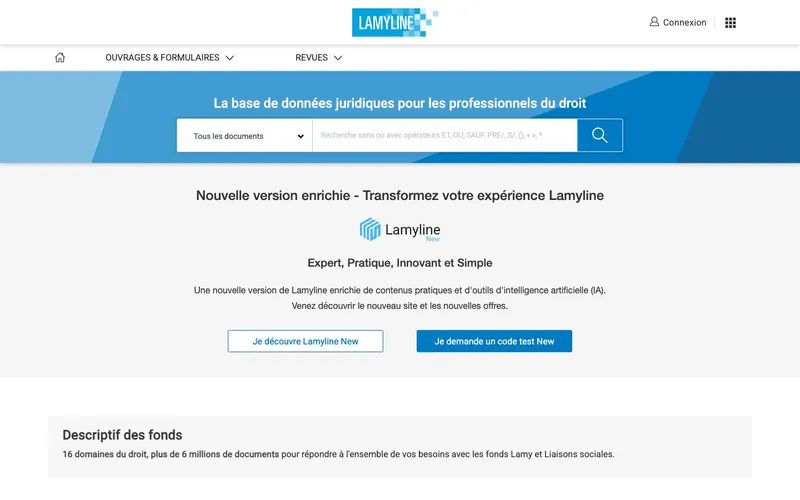
Case-law depth backed by a massive document base. Sovereignty 🟡 L2. From ~€132/month.
Lamyline is Dalloz’s historic competitor in legal publishing. With more than 7 million documents, more than 120 books and journals from Lamy Liaisons, and a community of more than 2,000 authors, the base is solid. Data is hosted in Sweden on Azure (source), which raises fewer concerns than US hosting but is not pure sovereignty (hence the L2 rating).
Strengths:
- Very rich case-law base, especially in business law, employment law and tax law
- More than 10,000 templates and formulas for drafting documents
- Integration with the Kleos firm management software
- Adaptable profiles (Expert and Operational)
Weaknesses:
- AI layer more recent than GenIA-L, still maturing
- Prompts not retained (a good point), but Azure infrastructure, so not 100% sovereign
- Fewer public user reviews than Dalloz
Our take: solid on case law, Lamy has genuine editorial expertise. An excellent daily working tool, but still a notch behind GenIA-L in conversational maturity.
Doctrine
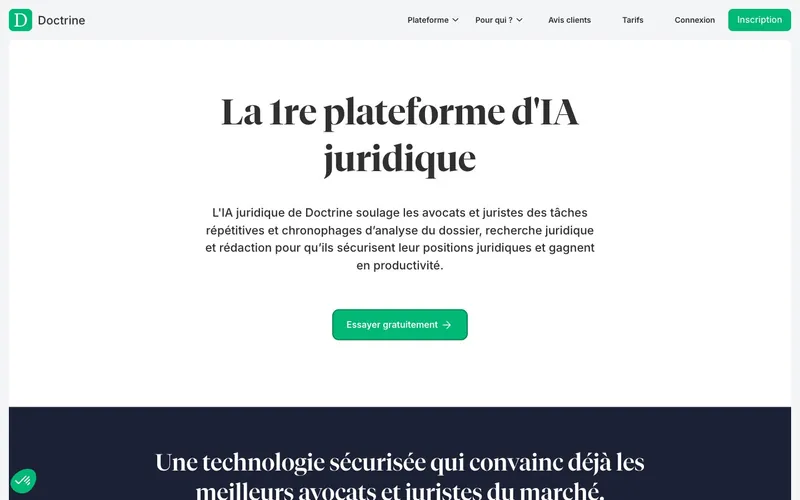
The reference for case-law research. Sovereignty 🟢 L1. From €159/month (€1,392/year), 7-day trial.
Doctrine revolutionized access to case law in France and has become a reflex for many lawyers. Partner of the Paris Bar, validated CNIL compliance, France hosting. Predictice recently merged with Doctrine, creating a combination of case-law research and predictive justice.
Strengths:
- One of the richest libraries on the market, with an unmatched volume of decisions
- Assistant reproducing the legal syllogism (major premise, minor premise, conclusion)
- Around 50% time savings per document according to users
Weaknesses:
- What’s missing is annotated doctrine: case commentary, analysis, annotations, the editorial work you find at Dalloz or Lamy
- The AI is an added layer, not the product’s historic core
Our take: formidable for case-law research. The library is massive. But if you need annotated doctrine and in-depth editorial analysis, GenIA-L remains ahead.
Predictice
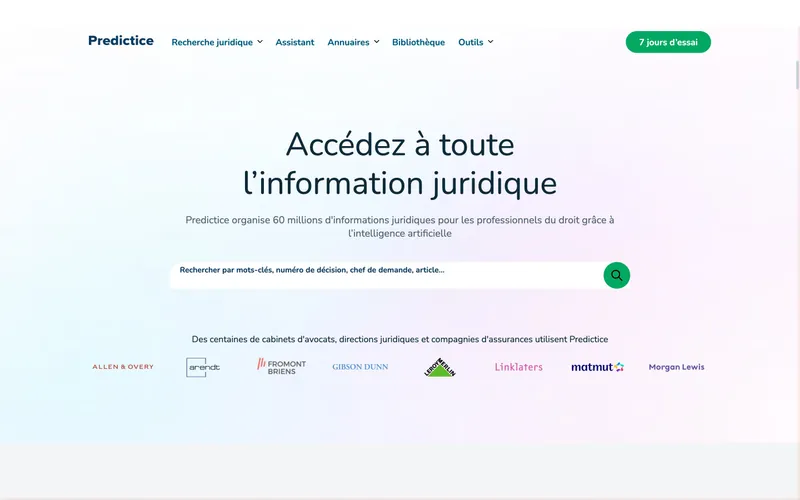
Predictive litigation analysis, unique in France. Sovereignty 🟢 L1. Quote-based.
Founded in 2016, Predictice draws on more than 60 million legal documents for predictive analysis. It’s the only truly predictive solution on the French market. It recently merged with Doctrine.
Strengths:
- Quantified analysis of success rates by court
- Estimation of likely compensation
- Automatic identification of relevant case law
- France hosting, strict GDPR
- Drafting assistant (GPT-based)
Weaknesses:
- Litigation-focused, of little use for pure advisory work or contract drafting
- Moderate learning curve
Our take: in its niche (litigation, dispute strategy), it’s unbeatable. But it’s a specialized tool, not a general-purpose assistant.
Ordalie
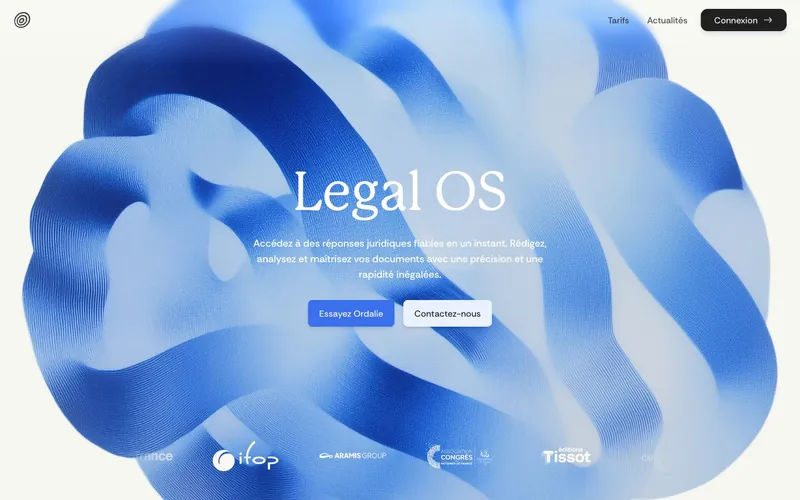
The best value-for-money sovereign option. Sovereignty 🟢 L1. €57 to €89/month.
Co-founded by Baudouin Arbarétier and Léa Fleury (ex-Baker McKenzie), Ordalie is rising fast out of Station F. Partnership with the Paris Bar (free for one year to Paris lawyers). Proprietary models trained specifically on French law, some of them released as open source.
Strengths:
- Very competitive pricing, by far the most affordable serious offering
- Claimed hallucination rate below 1% in production (a self-declared figure, see our hallucinations section)
- Unlimited queries
- France hosting, GDPR, data not exploited
- Intuitive interface, minimal training
Weaknesses:
- More limited proprietary library than the historic publishers: ideal as a complement to a base, less so as a replacement for a doctrinal subscription
- Young company, still limited hindsight on highly specialized uses
Our take: an excellent entry point for a solo lawyer or a small firm that wants sovereignty without blowing the budget.
Jimini AI
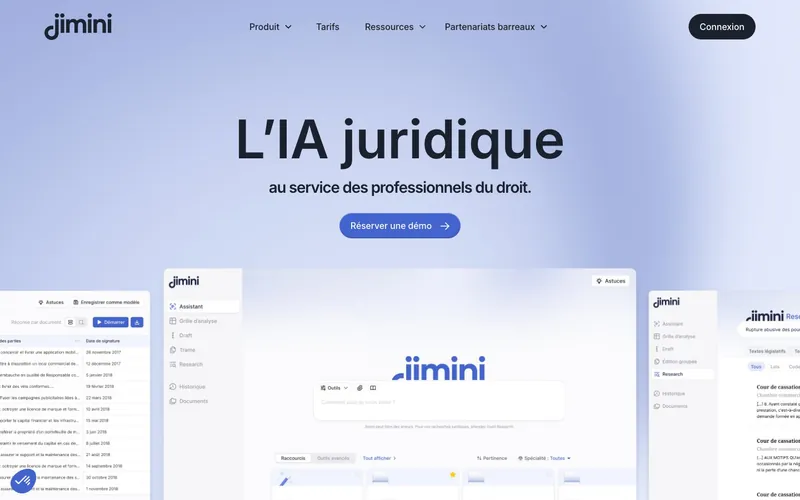
The solution backed by France 2030. Sovereignty 🟢 L1 (ISO 27001 + HDS). Quote-based.
Jimini raised €1.9M, is a France 2030 laureate (“Accelerating the use of generative AI in the economy”) and has a partnership with the Paris Bar (3 months free for firms with 1 to 20 lawyers).
Strengths:
- Affordable price for a complete solution
- 100% France hosting, sovereign cloud, certified ISO 27001 and HDS
- Around 50% time savings on repetitive tasks
- Simple interface, responsive French support
- Secure connection to external document bases
Weaknesses:
- Still basic features compared to the publishers (source)
- No proprietary library, the tool relies on external sources
- Less suited to complex litigation
Our take: a very good first contact. The France 2030 label and the HDS certification are strong institutional signals. For very advanced use, the documentary depth is still lacking.
Haiku (formerly Clerk)
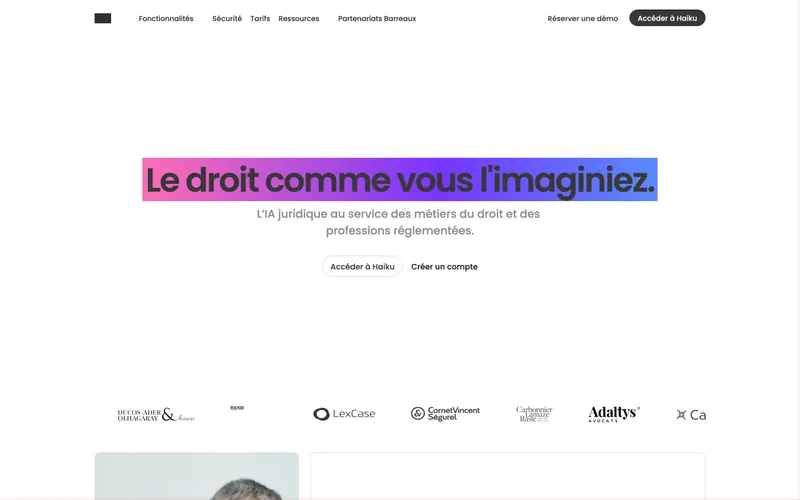
The rising Bordeaux challenger. Sovereignty 🟢 L1. Quote-based.
A startup founded in 2023, incubated at Unitec, with €1.3M raised. Partnership with the Bordeaux Bar since September 2025. The CEO is a law PhD candidate.
Strengths:
- Founders from the legal world, not just developers
- The tool draws on the user’s own firm’s document base
- Positive user feedback: “it doesn’t invent case law”
- European GDPR hosting
- A team of about a dozen people, so agile
Weaknesses:
- Still very young, little public feedback at scale
- No proprietary editorial library
Our take: a tool to watch closely. Founded by a law PhD candidate, Haiku is now a partner of many bar associations. The product evolves fast and stays very focused on user feedback, which makes it a genuine everyday tool, far from the over-engineered systems of some historic publishers.
Juri’Predis
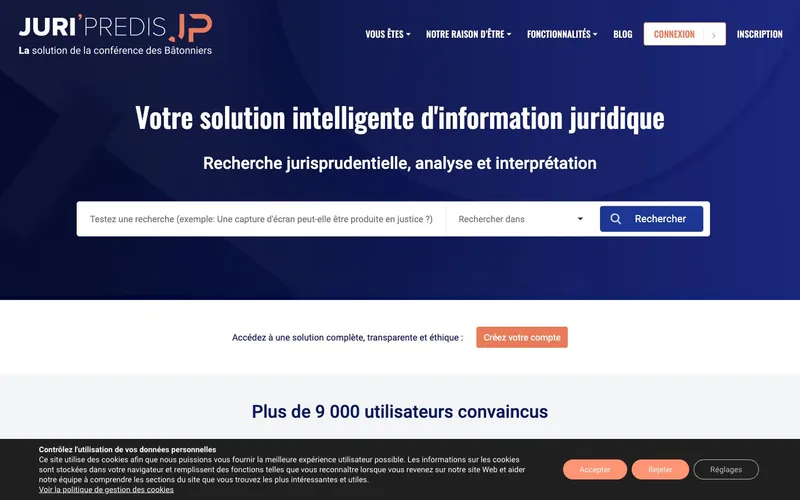
The veteran championed by the bars. Sovereignty 🟢 L1. Quote-based, 15-day trial.
9 years of experience, 33 million documents, 84 partner bars, more than 9,000 professionals.
Strengths:
- Algorithms that respect the logic of legal reasoning, not raw NLP
- Designed by legal and AI researchers, a dual skill set
- 84 partner bars, strong institutional adoption
- Intuitive interface
Weaknesses:
- Less in the media spotlight than the others
- No conversational assistant in the chatbot sense, it’s more of an augmented search engine
- Limited public documentation on performance
Our take: a solid, proven solution that’s often underrated. The fact that 84 bars trust it is a strong signal.
MCP Factory by Zevra
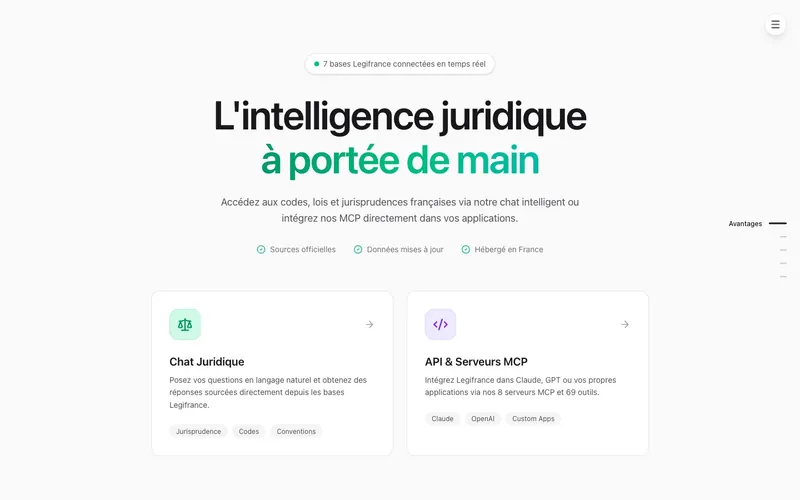
The open data infrastructure that plugs any LLM into French law. Sovereignty 🟢 L1. Open / API. mcp-juridique.fr
This isn’t a legal AI in the classic sense, it’s an infrastructure layer that connects any LLM (Claude, GPT, Gemini) to official French legal sources via the MCP protocol (Model Context Protocol).
In concrete terms:
- 8 MCP servers, 69 legal tools that can be embedded in any AI agent
- 7 Légifrance databases connected in real time (case law, codes, collective bargaining agreements)
- More than 2 million texts indexed, with direct synchronization via the government’s PISTE APIs
- No cache, no stale data, live updates
- Built-in legal chat on top of API access
Hosting: France, GDPR, OAuth2 and TLS, 99.9% uptime.
Our take: MCP Factory proves that a legal AI doesn’t need premium editorial libraries to perform well. You plug your Claude or GPT into the entirety of official French law: codes, statutes, case law, collective bargaining agreements. No annotated doctrine, but for 95% of practitioners’ needs, that’s enough. It’s also the bet we defend in the final section.
Dairia IA

A employment-law firm’s expertise turned into an AI avatar. Sovereignty 🟢 L1. From €90/month, 7-day trial. dairia.ai
Dairia Avocats is a Lyon-based law firm founded by Sofiane Coly, specialized in employment law for 10 years. They created an assistant that is literally the virtual avatar of their firm’s expertise.
In concrete terms:
- Conversational assistant 100% employment law: Labour Code, payroll, URSSAF, social security
- Trained and supervised by the firm’s lawyers, not a mere GPT wrapper
- Answers in plain language, designed for small-business owners and SME executives, HR managers, chartered accountants
- Downloadable template documents
- Escalation to a real lawyer when the case exceeds the AI
Security: end-to-end encryption, GDPR, data not shared.
Our take: the “augmented firm” model that monetizes a real firm’s expertise. The SME client gets 24/7 access to expertise that would cost far more in a conventional consultation. Hyper-niche (employment law only), but clever.
International solutions
Beyond the French market, several international players carry significant weight, especially for corporate firms and multi-jurisdiction organizations. Their common feature: real power, but sovereignty to watch closely (L3) for anyone handling sensitive client data under French law.
Harvey AI
International corporate law firms. Sovereignty 🟠 L3 (US hosting). ~$1,000 to $1,200/month per user.
Harvey is the reference for large Anglo-American firms and a few CAC 40 organizations. Impressive generative power, integration into firm workflows, processing of huge document volumes. The flip side: American hosting, OpenAI-family models, hence exposure to the Cloud Act and common-law bias to watch in civil-law jurisdictions. The price puts it out of reach for an average French firm.
Verdict: excellent for international M&A and corporate work, but ill-suited to the French firm concerned with sovereignty.
Lexis+ AI (LexisNexis)
The global document library. Sovereignty 🟠 L3. Quote-based, high price.
Backed by one of the world’s largest document libraries, Lexis+ AI appeals to international organizations that are already LexisNexis clients. Documentary depth and an established brand, but sovereignty to verify (the American group RELX) and localization to French law sometimes lagging behind Dalloz. Worth noting: the ongoing tie-up between RELX/LexisNexis and Doctrine could reshuffle the French market.
Verdict: relevant for international organizations, to be assessed carefully on data localization.
Spellbook
Contract drafting inside Word. Sovereignty 🟠 L3. ~$100 to $200/month.
A Word add-in that generates and reviews clauses. Native integration into the drafting flow, fast adoption. But the tool is designed for Anglo-American law (clauses, formats) and hosting is North American.
Verdict: handy for contracts in English. For the French market, Oro/Tomorro is better suited.
Legora (formerly Leya)
The European multi-model challenger. Sovereignty to be confirmed. Quote-based.
An assistant for firms taking a multi-LLM approach, with strong traction in Northern Europe. Rising fast. Data localization for France remains to be confirmed before any use on sensitive documents.
Verdict: a player to watch in the coming months.
Niche tools
| Tool | Specialty | Strong point | Sovereignty |
|---|---|---|---|
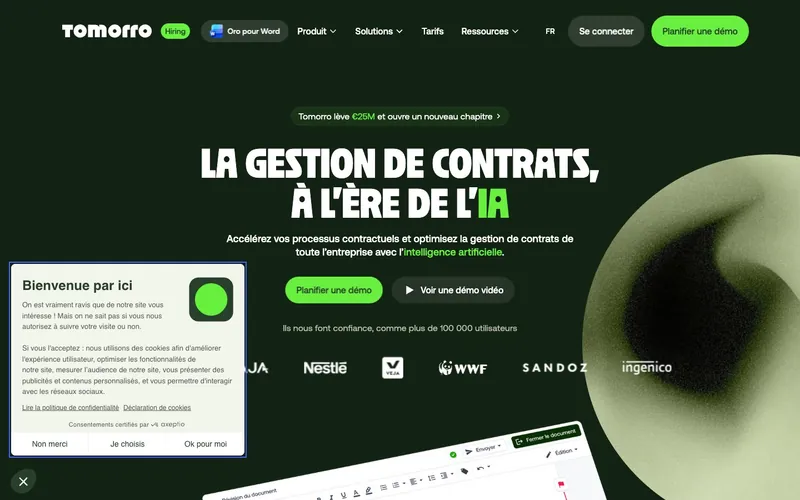
| Oro (Tomorro) | Contract drafting and management | French CLM reference. ISO 27001. Clients: Nestlé, Clarins, Vinci. €25M raised | 🟡 L2 |
| Lexbase | Legal research and publishing | One of France’s first legaltechs (1998), proprietary library, sovereign hosting | 🟢 L1 |
| Jus Mundi | International law and arbitration | Unique multilingual base, essential in international arbitration | 🟡 L2 |
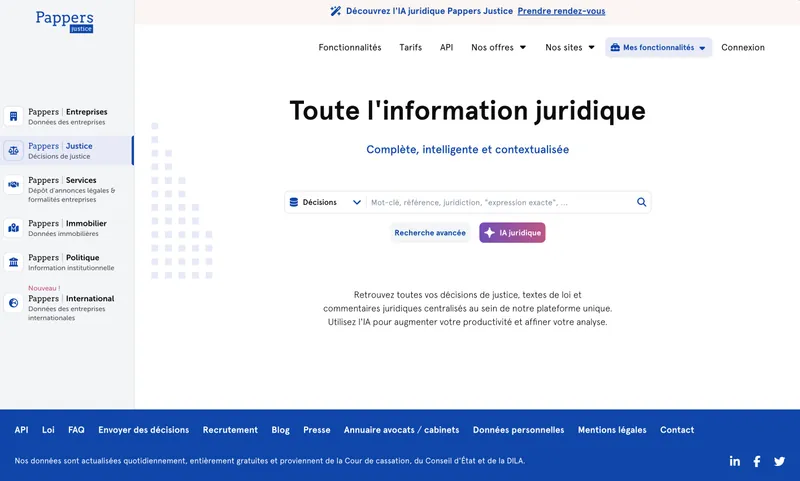
| Pappers Justice | Open data case law | 1.5M decisions freely accessible and a JSON API. The best free option | 🟢 L1 |
| Juribot | Free consumer assistant | French law, free access | 🟢 L1 |
Which legal AI for which profile
Rather than a single ranking, here is a profile-by-profile reading. The right solution depends first on your practice and the level of sovereignty you require.
| Profile | Dominant need | Main recommendation | Budget alternative |
|---|---|---|---|
| Solo lawyer, small firm | Research and drafting, tight budget | Ordalie (€57 to €89/month) | MCP Factory (open data) |
| Litigation firm | Case law and procedural strategy | Doctrine + Predictice | Juri’Predis |
| Corporate / business law firm | Annotated doctrine and contract volumes | GenIA-L + Oro/Tomorro | Lamyline New |
| Corporate legal department | Contract management, compliance, volume | Oro/Tomorro + GenIA-L | Lexis+ AI if already a client |
| Specialized employment law | Employment advice, payroll, URSSAF | Dairia IA | Lamyline New (employment library) |
| Arbitration, international law | Multilingual sources | Jus Mundi | Lexis+ AI |
| International firm (M&A) | Anglo-American power and volume | Harvey or Legora | sovereignty caution |
Summary matrix
| Criterion | GenIA-L | Lamyline | Doctrine | Predictice | Ordalie | Jimini | Haiku | Juri’Predis | MCP Factory | Dairia |
|---|---|---|---|---|---|---|---|---|---|---|
| Reliability | ★★★★★ | ★★★★ | ★★★★ | ★★★★ | ★★★★ | ★★★ | ★★★ | ★★★★ | ★★★★ | ★★★★ |
| Doctrinal library | ★★★★★ | ★★★★★ | ★★★ | ★★★ | ★★ | ★★ | ★★ | ★★★ | ✗ | ★★★ |
| Case law | ★★★★ | ★★★★ | ★★★★★ | ★★★★★ | ★★★ | ★★★ | ★★★ | ★★★★★ | ★★★★ | ★★★ |
| Sovereignty | 🟢 L1 | 🟡 L2 | 🟢 L1 | 🟢 L1 | 🟢 L1 | 🟢 L1 | 🟢 L1 | 🟢 L1 | 🟢 L1 | 🟢 L1 |
| Predictive | ✗ | ✗ | ✗ | ★★★★★ | ✗ | ✗ | ✗ | ✗ | ✗ | ✗ |
| Contracts | ★★★ | ★★★★ | ✗ | ✗ | ★★★ | ★★★ | ★★★ | ✗ | ✗ | ✗ |
| Price | €€€ | €€€ | €€ | €€€ | € | €€ | €€ | €€ | € | € |
Verdict and tier list
The right tool depends on your profile (see the matrix above) and the level of sovereignty you require. With those caveats, here is our ranking.
Tier S, the most comprehensive editorial library:
- GenIA-L (Dalloz): the combination of a century-old editorial library and cutting-edge AI makes it the reference in French law.
Tier A, excellent in their field:
- Lamyline New: solid on case law and business law
- Doctrine: one of the richest libraries on the market, reinforced by the Predictice merger
- Predictice: predictive analysis, one of a kind
Tier B, best value for money:
- Ordalie: the most attractive price/quality ratio in the sovereign category
- Jimini: a good first contact, strong institutional backing
- Juri’Predis: the quiet veteran, 84 partner bars
- MCP Factory: the best open data infrastructure
Tier C, promising niches:
- Haiku: promising but still young
- Oro/Tomorro: the French reference for contracts
- Dairia IA: a clever “augmented firm” model, hyper-niche employment law
International, sovereignty caution:
- Harvey, Lexis+ AI, Spellbook, Legora: powerful, but to be reserved for uses compatible with L3 hosting.
The hallucination problem
The main risk of a legal AI remains hallucinations. General-purpose LLMs hallucinate between 69% and 88% of the time on legal queries (GPT-3.5: 69%, PaLM 2: 72%, Llama 2: 88%). Even with RAG, specialized tools keep a hallucination rate of 17% to 33% depending on the tests. GenIA-L comes out with 92 to 93% satisfaction. Ordalie claims less than 1% hallucination, but this figure is self-declared and not independently verified.
The CNB published a 12-criteria self-assessment grid (security, ethics, legal quality) to help with the choice.
The ethics point: a low hallucination rate never removes the need to verify sources. It reduces the cost, not the necessity. Whatever the tool, the lawyer remains responsible for the content they produce. Human oversight isn’t an optional best practice, it’s an obligation.
The AI Act and legal AI in 2026
The European regulation on artificial intelligence (AI Act, EU Regulation 2024/1689) is coming into force in stages. For law firms, the essentials are:
- Everything depends on the use. A document-research assistant and a tool that helps make judicial decisions don’t fall into the same risk category. The more the use touches a decision affecting a person’s rights, the heavier the obligations.
- Transparency becomes enforceable. You are entitled to ask a publisher for clear information about the model used, the origin of the training data and the location of the hosting. That’s precisely what our sovereignty grid measures.
- Cumulative compliance. GDPR, professional secrecy and the AI Act stack up. Data sovereignty is no longer a marketing argument, it’s a compliance battleground.
Application deadlines run from 2025 to 2027 depending on the obligations. Check the timeline applicable to your use before any firm-wide deployment.
Outlook at 1, 3 and 5 years
- In 1 year: widespread adoption of sovereign French assistants and continued market consolidation (the Doctrine/Predictice merger, moves around LexisNexis). The entry price falls, the offering becomes clearer.
- In 3 years: open data (Judilibre, Légifrance, near-complete administrative open data) makes raw research almost free. Value migrates to annotated doctrine and specialized agents connected to official sources (the MCP logic). The structural advantage will go to whoever masters the data infrastructure.
- In 5 years: autonomous yet supervised legal agents, integrated into the firm’s workflow. The question will no longer be “which AI” but “which data architecture and what level of sovereignty.”
This trajectory reinforces one conviction: the future belongs to the combination of open data plus engineering, not to closed libraries alone.
FAQ
What is the best legal AI in France in 2026? For general-purpose use with the most comprehensive library, GenIA-L (Dalloz) comes out on top. But the “best” depends on your profile: Ordalie for value for money, Doctrine for case law, Predictice for predictive analysis. See our profile-by-profile matrix.
Which legal AI for a solo lawyer on a small budget? Ordalie (€57 to €89/month) offers the best sovereign compromise. For a free, flexible approach, MCP Factory plugs your LLM into French legal open data.
Is a legal AI compatible with professional secrecy? Yes, provided you choose an L1-level tool (sovereign hosting, encrypted data not reused). A simple “hosted in France” label is not enough: demand verifiable guarantees. See the sovereignty grid.
Do legal AIs still hallucinate? Yes, but far less than general-purpose LLMs. Specialized tools with RAG drop to 17 to 33% depending on the tests, the best publishers claim more than 90% reliability. Source verification by the lawyer remains essential.
Should you prefer a sovereign French AI over Harvey or Lexis+ AI? For a French firm handling sensitive client data, yes: the French L1 solutions better protect professional secrecy. Harvey and Lexis+ AI retain their value for international organizations and non-sensitive uses.
How much does a legal AI cost? From free (open data, Pappers Justice) to more than $1,000/month (Harvey). The core of the sovereign French market sits between €60 and €200/month per user. The historic publishers often operate on a quote basis.
Are ChatGPT or Claude enough for legal work? For brainstorming or rephrasing, yes. For producing reliable, sourced legal work, no: these general-purpose models hallucinate heavily on legal queries and offer no sovereignty guarantee in their consumer versions. A specialized tool or an MCP Factory-type infrastructure is necessary.
What does legal open data change in practice? It makes case law (Judilibre, administrative justice) and legislation (Légifrance) free and accessible. A good RAG on these sources covers around 95% of practitioners’ needs. See our dedicated section.
Does the AI Act impose obligations on law firms? Yes, proportionate to the use. The essentials: demand transparency from the publisher and document the sovereignty level of the tool used.
How do you objectively assess a legal AI? Use the CNB’s 12-criteria self-assessment grid (security, ethics, legal quality) and cross-reference it with our sovereignty grid.
Why open data is the future of legal AI
A proprietary document library matters for the quality of the output, but today open source and the available APIs already deliver exceptional results and cover 95% of practitioners’ needs.
The free legal data available in France
| Source | Content | Access |
|---|---|---|
| Judilibre API (Court of Cassation) | Around 480,000 decisions pseudonymized since 1947 | Free via PISTE |
| Administrative justice open data | All decisions from the 42 administrative courts, 9 appeal courts and the Council of State | Free |
| ArianeWeb (Council of State) | More than 270,000 decisions with analysis and the public rapporteur’s conclusions | Free |
| Légifrance / DILA API | 73 codes in force consolidated and 29 repealed, statutes, ordinances, decrees | Free via PISTE |
| Pappers Justice | 1.5 million decisions and a structured JSON API with enriched metadata | Free (and premium) |
France releases around 3.9 million decisions per year. The regulatory timeline expected nearly all judicial and administrative decisions to be in open data by the end of 2025. This is no longer a project, it’s the law (Article L111-13 of the Code of Judicial Organization), stemming from the 2016 Digital Republic Act.
What open data covers
- Finding the applicable statute: Légifrance API, free, consolidated, up to date
- Finding relevant case law: Judilibre, Pappers Justice and administrative open data
- Checking the state of positive law: Légifrance, this is the Official Journal
- Drafting a standard document: prompts on positive law sourced from open data give excellent results
- Preparing for a hearing: the case law of the relevant court is available in open data
A well-built RAG on Judilibre, Légifrance and Pappers, with a good LLM behind it, already delivers very high quality results, without an editorial subscription.
The 5% that open data doesn’t cover
| Gap | What it represents | Who provides it |
|---|---|---|
| Annotated doctrine | Annotations of articles by professors and practitioners, commentary on decisions | Dalloz, Lamy, Lexbase, LextenSo |
| Annotated codes | An article with 15 years of case law sorted and commented by a specialist | Dalloz, Lamy |
| Editorialization | Ranking the importance of a decision (reported in the Bulletin or unpublished) | Historic publishers |
| Specialized journals | JCP, Recueil Dalloz, AJDA, RDC, the living doctrinal debate | Publishers exclusively |
As a Cairn study notes, open data has forced publishers to focus on their true added value: editorial engineering. The real question for a firm today: do my 5% of complex cases justify a premium editorial subscription, or can I get by with an open data solution supplemented by an occasional consultation when I need one?
For many firms, the most relevant solution isn’t the most expensive, it’s the one that covers their real needs at the right price.
Our testing methodology
1. Real-world tests. Each solution was tested on concrete use cases drawn from our practice: case-law research (employment law, contract law, criminal law), clause drafting, decision analysis, compliance checks.
2. Evaluation criteria. Seven criteria: answer reliability (manual source verification), library comprehensiveness, sourcing quality, data sovereignty, ergonomics, value for money, relevance for a general practitioner.
3. Institutional cross-checking. Our results were compared against the CNB’s evaluations (12 solutions, March 2025), its self-assessment grid and the independent comparisons by Meta-Doctrinal, Pamplemousse Magazine and AvocatCity.
4. Hallucination benchmarks. Data from published, verifiable research: a Stanford/Yale study and an IA Focus Magazine analysis.
5. Prices. Compiled from our directory of 184 legaltechs and verified on publishers’ websites in May 2026. “Quote-based” prices depend on the number of users.
6. Independence. No affiliate links. No solution paid us or granted privileged access in exchange for a favorable review.
This article is updated regularly. Last revision: June 2026. The full individual reviews of each solution will be published progressively.
To go further: Data sovereignty: definition and stakes for lawyers, AI hallucinations: definition, mechanisms and solutions, Legal RAG: the complete guide and our legaltech directory.
Sources
- 2026 Guide, which legal AI to choose (Meta-Doctrinal)
- Legal AIs 2026, complete comparison (Pamplemousse Magazine)
- Top 5 best legal AIs 2026 (AvocatCity)
- GenIA-L, Lefebvre Dalloz
- Dalloz AI / GenIA-L review (JusticeIA)
- Full GenIA-L for Search test (Polyope)
- Ordalie IA review (JusticeIA)
- Jimini AI, official site
- France 2030 chooses Jimini AI (Le Monde du Droit)
- Paris Bar x Jimini partnership
- Haiku, Bordeaux Bar
- Predictice review 2025 (JusticeIA)
- Doctrine.fr review (LegalConseil)
- Juri’Predis, official site
- MCP Factory, Zevra
- Dairia IA
- Dairia Avocats (Décideurs Magazine)
- Legal AI and hallucinations (IA Focus Magazine)
- Legal hallucinations (ActuIA)
- CNB, legal AI evaluation grid
- AI survey March 2025, CNB / Viavoice
- Paris Bar 2025 AI offerings
- Lamyline New, Wolters Kluwer
- Tomorro / Oro
- Pappers Justice
- Judilibre API (data.gouv.fr)
- Administrative justice open data
- Légifrance / DILA API
- AI Act, EU Regulation 2024/1689
- Digital Republic Act, legal framework (Predictice)
- Open data and legal publishers (Cairn)