
Last updated: August 2026 | Reading time: 30 min
Which legal AI should you choose in 2026? The French market now counts around twenty serious solutions, from century-old publishers (GenIA-L by the Lefebvre group, LamyLia) to French pure players (Ordalie, Jimini, Haiku) all the way to the American giants (Harvey, Lexis+ AI). We tested the available solutions, cross-checked our results against data from the CNB — French National Bar Council (March 2025), the independent comparisons by Meta-Doctrinal, Pamplemousse Magazine and Le Barreaumètre, as well as academic benchmarks on LLM hallucinations. And we did what nobody else does: trace the data-processing chain link by link, hosting provider, model and inference operator included.
The result unsettles the sector’s marketing narrative: out of 21 solutions put under scrutiny, only one currently holds end-to-end sovereignty on published evidence, and two others come close subject to confirmation. Everything else routes your data, at one link or another, through an entity subject to US law. That is the heart of this edition.
August 2026 edition: what changed
This overhaul replaces the June 2026 version. What changed: the sovereignty grid goes from 4 to 5 levels and now includes the model layer (the link everyone was overlooking, ourselves included); most N1 badges fall away; Doctrine and Predictice are covered together (Predictice acquired by Doctrine, then an agreement for RELX/LexisNexis to acquire the whole signed in April 2026); Lamyline is reattributed to its actual publisher, Lamy Liaisons of the Swedish Karnov group (no longer Wolters Kluwer, which exited in 2022); three new entries appear: Legaia, Legora and Lexform; prices are refreshed as of August 2026.
Methodology
All tests were carried out by legal and legaltech practitioners in a controlled environment: same queries, same use cases (case-law research, drafting, contract analysis, litigation preparation). Our results were cross-checked against institutional data from the French National Bar Council and the Paris Bar, and against research on the reliability of legal LLMs. Each tool’s sovereignty chain (hosting provider, model provider, inference operator) was verified against publishers’ public documentation and the trade press. Prices were verified on publishers’ websites in August 2026. No affiliate links, no commercial partnerships: this review is independent.
Contents
- The five-level data sovereignty grid
- Comparison table of the 21 solutions
- GenIA-L by the Lefebvre group
- LamyLia and Lamyline (Lamy Liaisons, Karnov group)
- Doctrine + Predictice (RELX acquisition pending)
- Ordalie
- Jimini AI
- Haiku, formerly Clerk
- Juri’Predis
- MCP Factory by Zevra
- Dairia IA
- Legaia
- International solutions
- Niche tools
- Which legal AI for which profile
- Summary matrix
- Verdict and tier list
- The hallucination problem
- The AI Act and legal AI in 2026
- Outlook at 1, 3 and 5 years
- FAQ
- Why open data is the future of legal AI
- Our testing methodology
The five-level data sovereignty grid
For a lawyer, professional secrecy is not optional. The CNB’s AI working group points out that a bare “hosted in France” claim is “neither sufficient nor verifiable”. We take that remark literally, and we go further than our own June grid: assessing where the application is hosted is not enough, you have to follow the full data flow.
The critical moment is inference. When you submit a case document to an AI assistant, its content travels inside a prompt to the model provider. A French publisher, hosted in France, calling the OpenAI, Anthropic or Google API routes your data through an entity subject to US law (Cloud Act, FISA) at precisely the moment it is most exposed. The question “which model, executed where, operated by whom” is therefore the pivot of the grid.
| Level | Cumulative criteria | Exposure to US law | Recommended use |
|---|---|---|---|
| 🟢 N1 sovereign end to end | Controlled model (self-hosted open source or in-house proprietary) executed on EU infrastructure not subject to US law, EU hosting provider, publisher under EU ownership, no outbound call to any US-law entity anywhere in the chain (inference, OCR, embeddings, analytics) | None by construction | Named documents, data covered by professional secrecy |
| 🟡 N2 sovereign hosting, US model | Application and storage with an EU hosting provider, but inference through a US model (OpenAI, Anthropic, Google), even deployed in an EU region, even with contractual Zero Data Retention | Prompt content transits a US-law entity at the most sensitive moment | Pseudonymised data, research on public sources |
| 🟠 N3 US infrastructure in an EU region | Storage or application layer with a US hyperscaler (Azure, AWS, GCP, DigitalOcean, Supabase) even in an EU region, or publisher now under non-EU control | Cloud Act applies to the host, data at rest included | Monitoring, work on public data |
| 🔴 N4 outside the EU, contractually framed | Hosting or inference outside the EU, contractual guarantees only (standard clauses, DPF), or no public documentation at all | Real, contractually framed at best | Non-sensitive tasks, international matters |
| ⚫ N5 uncontrolled | Consumer tool with no professional contract, data potentially reused | Total | To be avoided for any client data |
Four reading rules come with the grid. They are what separates this from comparisons that copy publishers’ marketing pages.
Rule 1: the level is proven, not declared. Without a public technical sheet naming the hosting provider, the model provider and the retention regime, the tool is classified “unverifiable” and downgraded one level. This applies the CNB’s position directly.
Rule 2: the level is that of the weakest link in the chain. A sovereign application with US inference is N2. A sovereign model on US hosting is N3.
Rule 3: upstream pseudonymisation changes the maths. An N2 or N3 tool fed pseudonymised data becomes usable beyond its nominal level. Three routes reconcile AI with professional secrecy: local execution, sovereign cloud, and pseudonymisation.
Rule 4: the nationality of the model weights is not the criterion, what counts is the inference operator and its jurisdiction. A Google model or a Llama executed inside a SecNumCloud perimeter operated by a French entity stays within the controlled flow. A Mistral called through Azure or Bedrock leaves it. Demanding French microprocessors would be utopian; demanding control of the flow is not.
The third route: pseudonymise before sending
Rule 3 deserves a word, because it reconciles two realities: the best models on the market are American, and professional secrecy is not negotiable. Pseudonymising documents before submitting them to an AI (names, companies, addresses replaced by neutral tokens) lets you use an N2 or N3 tool without exposing your clients’ identities. That is exactly what Lexform, our pseudonymisation firewall, does: browser extension and API, engine developed and operated by us on OVHcloud GPUs in Gravelines, application on Scaleway in the Paris region, no third-party AI API, zero retention, mapping table kept on your machine and never server-side. Roughly 4,000 pages pseudonymised for €16, no subscription. We publish the full sovereignty sheet, link by link: exactly the level of transparency this grid demands of every publisher, ourselves included.
Comparison table of the 21 solutions
Indicative prices excluding VAT, verified in August 2026 on publishers’ websites and in the trade press, compiled from our directory of 184 legaltechs. They may change and often depend on the number of users. The “Chain” column summarises hosting provider / model, based on public documentation; “n/a” flags information the publisher does not disclose.
| Tool | Type | Indicative price | Chain (host / model) | Sovereignty |
|---|---|---|---|---|
| GenIA-L (Lefebvre group) | Assistant + editorial corpus | on quote (~€250/month/user observed, quotas) | Azure / OpenAI | 🟠 N3 |
| LamyLia / Lamyline (Lamy Liaisons, Karnov) | Assistant + editorial corpus | from ~€132/month | Azure Sweden / n/a | 🟠 N3 |
| Doctrine + Predictice (RELX acquisition pending) | Research + predictive | from €159/month (€1,392/year) | AWS (to be confirmed) / GPT | 🟠 N3 |
| Ordalie | Generalist assistant | free tier; PRO from €69; MAX from €99 | France (host not named) / proprietary models | 🟢 N1 claimed, awaiting proof |
| Jimini AI | Assistant + automation | on quote | Scaleway / OpenAI (ZDR) | 🟡 N2 |
| Haiku (formerly Clerk) | Agentic assistant on firm corpus | on quote | S3NS SecNumCloud / in-house + Mistral + Google | 🟢 N1 subject to inference |
| Juri’Predis | Research + monitoring + generative AI | on quote (15-day trial) | EU (host not named) / Mistral | 🟡 N2 subject to hosting and inference |
| MCP Factory (Zevra) | Open data infrastructure | open / API | France (Zevra) / user’s choice | 🟢 N1 infrastructure, final level depends on the model plugged in |
| Dairia IA | Employment law niche | €179/month | Supabase (AWS) / n/a | 🟠 N3 |
| Legaia | Assistant by email | on request | France claimed (unverifiable) / ChatGPT | 🟠 N3 |
| Harvey AI | Business law firms | ~$1,000 to $1,200/month | US / OpenAI | 🔴 N4 |
| Lexis+ AI (LexisNexis) | Assistant + global corpus | on quote (high) | RELX group, EU-US / n/a | 🔴 N4 |
| Spellbook | Contract drafting (Word) | ~$100 to $200/month | US-Canada / OpenAI | 🔴 N4 |
| Legora (formerly Leya) | Multi-model assistant | on quote | n/a / multi-LLM | 🟠 N3 |
| Oro / Tomorro | Contracts (CLM) | on quote | EU (host to be documented) / n/a | 🟡 N2 |
| Lexbase | Research + publishing | on quote | France claimed / n/a | 🟡 N2 |
| Jus Mundi | International law, arbitration | on quote | OVH / n/a | 🟡 N2 subject to inference |
| Pappers Justice | Open data case law | free (and premium) | n/a / n/a | 🟡 N2 |
| Juribot | Free consumer assistant | free | no published data | 🔴 N4 |
| Lexform (Zevra) | Pseudonymisation before AI | free 8,000 words/month, then prepaid credits | Scaleway + OVH Gravelines / in-house model | 🟢 N1 |
The table speaks for itself: end-to-end N1, proven and published, can be counted on one hand. There were ten green badges in our June edition. It was not the market that had changed, it was our grid that was not looking at the right link.
GenIA-L by the Lefebvre group
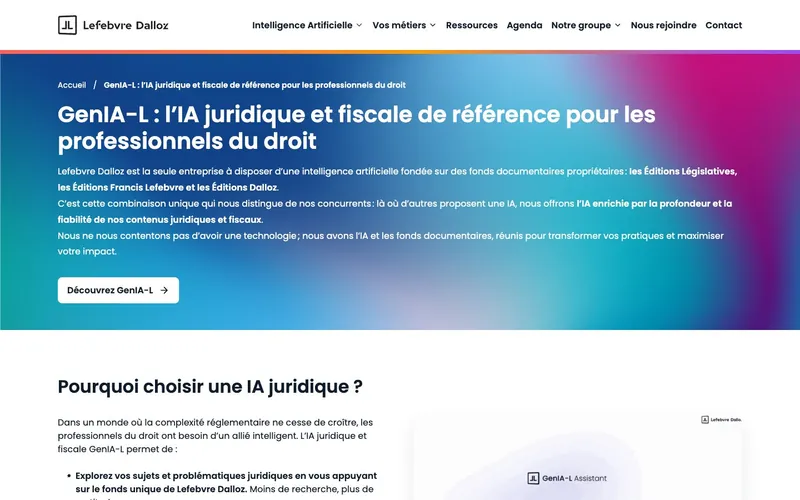
The most complete editorial corpus on the French market. Sovereignty 🟠 N3. On quote, around €250/month/user observed.
GenIA-L rests on a structural advantage nobody can easily replicate: the Dalloz, Francis Lefebvre and Éditions Législatives corpora, updated daily. When you ask it a question, the tool does not search the web: it draws on its own commentary, its own annotated codes, its own annotated case law, through a RAG architecture.
On sovereignty, the facts are public and openly acknowledged: the Lefebvre group chose OpenAI’s LLMs for both GenIA-L Search and GenIA-L Assistant, a choice claimed by the group’s leadership. GenIA-L even received an award from OpenAI in early 2026, with more than 100 billion tokens processed every month. Hosting runs on Azure (Le Barreaumètre). European publisher, European corpus, but American model and infrastructure: N3 in our grid, which takes nothing away from the quality of the product.
Strengths:
- Reliability rate of 92 to 93% in comparative tests, the highest on the French market
- Source traceability: every answer points back to articles, decisions and scholarly commentary
- Structured answers: summaries, worked cases, points of caution, reproducing legal reasoning
- Wide adoption: more than 45,000 clients claimed across Europe
Weaknesses:
- Opaque, high pricing: on quote, with around €250 per month per user observed for a firm of fewer than 50 lawyers, alongside monthly quotas of 200 to 300 queries; the Diapaz-integrated offer was announced between €2,000 and €2,500 per licence
- N3 sovereignty: OpenAI inference and Azure foundation, to be reserved for public or pseudonymised data
- Less automation than some competitors (no advanced contract drafting, no predictive analytics)
Our take: GenIA-L’s strength is that the AI remains an interface layer on top of an irreplaceable editorial corpus. Where others run RAG on open data, the Lefebvre group holds 200 years of proprietary commentary. GenIA-L remains the qualitative benchmark for French law, provided you accept the OpenAI + Azure pairing, or feed it only pseudonymised data.
LamyLia and Lamyline (Lamy Liaisons, Karnov group)
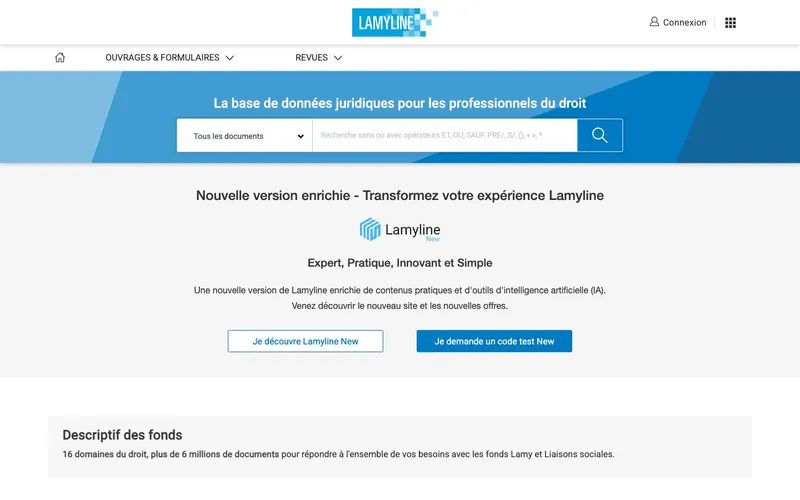
Case-law depth backed by a massive documentary base. Sovereignty 🟠 N3. From ~€132/month.
A correction first, because it still circulates everywhere, including in our previous edition: Lamyline no longer belongs to Wolters Kluwer. Lamy Liaisons came under Swedish ownership in November 2022 when Karnov Group acquired it, taking the entire capital of Wolters Kluwer France. The AI assistant is now called LamyLia, sitting on the Lamyline documentary platform. Hosting in Sweden on Azure, long presented as an oddity, suddenly makes sense: it is the Karnov group’s infrastructure.
Strengths:
- Very rich case-law base, especially in business law, employment law and tax law, with more than 7 million documents and over 2,000 authors
- More than 10,000 templates and precedents for drafting
- LamyLia produces structured legal memos (issue, applicable law, analysis, conclusion) showing its reasoning phase and sources
- Publisher under European ownership (Karnov, Sweden)
Weaknesses:
- AI layer more recent than GenIA-L, still maturing, and model provider not publicly disclosed
- Azure infrastructure: EU region, but American operator, hence N3
- Fewer public user reports than the Lefebvre group
Our take: solid on case law, Lamy has genuine editorial craft, particularly on the employment law corpus. An excellent day-to-day working tool, still a notch behind GenIA-L in conversational maturity.
Doctrine + Predictice (RELX acquisition pending)
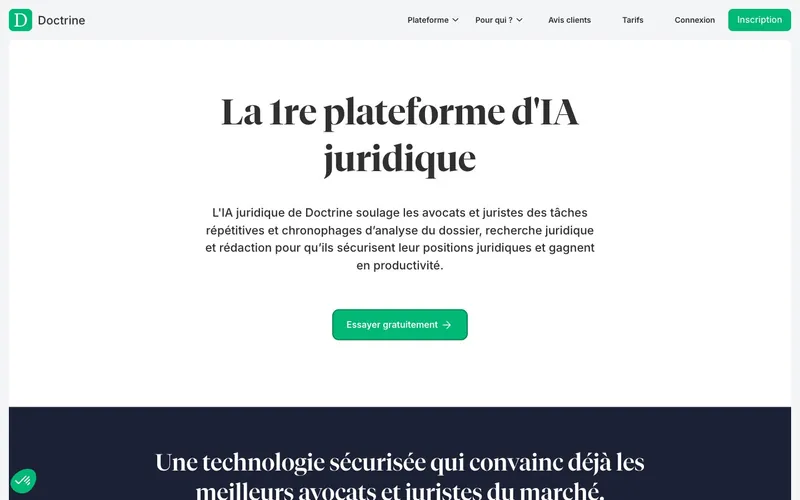
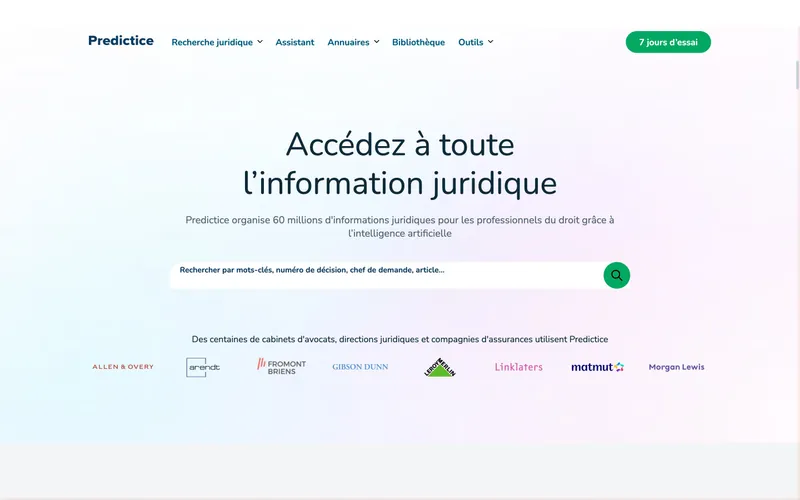
The benchmark for case-law research, now in the LexisNexis orbit. Sovereignty 🟠 N3. From €159/month (€1,392/year).
We now cover Doctrine and Predictice together, because the market did it for us: Predictice was acquired by Doctrine, and RELX, owner of LexisNexis, announced on 28 April 2026 an agreement to acquire Doctrine, subject to works council consultations and regulatory approvals, with both companies operating separately in the meantime. In other words, France’s champion of case-law research and the country’s only predictive analytics player are on their way into a non-European group. The “French publisher” badge from our June edition did not survive the spring.
On the technical chain: Predictice’s drafting assistant is GPT-based, and Doctrine’s hosting is located with AWS in Germany according to Le Barreaumètre, information we are still seeking to confirm with the publisher. American infrastructure, American inference, ownership in transfer: N3.
Strengths:
- One of the richest case-law corpora on the market, unmatched volume of decisions
- Assistant reproducing legal syllogism (major premise, minor premise, conclusion)
- Predictice’s predictive analytics (chances of success by court, damages estimates) remains unique in France
- Paris Bar partner, CNIL compliance validated
Weaknesses:
- The price/technology ratio no longer holds. From €1,392 per year per user, the subscription is priced on a historical advantage, access to case-law data, that the French Digital Republic Act has commoditised. Judilibre, administrative open data and players such as Pappers Justice now cover nearly the same need for a fraction of the price
- Annotated commentary, annotations and editorial work remain with the traditional publishers
- The question every client should ask before renewing: what happens to a Doctrine subscription inside the LexisNexis portfolio, in terms of price, product and data location?
Our take: formidable for case-law research, and the corpus is massive. But the gap with open data narrows every quarter, and the RELX acquisition reshuffles every card: sovereignty, pricing, roadmap. For a litigation firm signing today, prudence calls for a serious comparison with Juri’Predis and open data solutions before committing €1,400 per year per user.
Ordalie
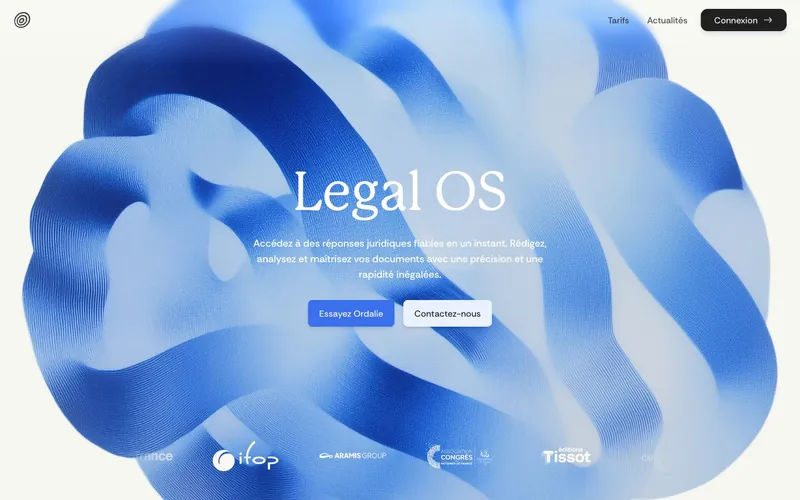
The best value for money on the sovereign market. Sovereignty 🟢 N1 claimed, awaiting proof. Free tier, PRO from €69/month, MAX from €99/month.
Co-founded by Baudouin Arbarétier and Léa Fleury (formerly Baker McKenzie), Ordalie is rising fast out of Station F, with a €1.8 million round closed in 2025 and more than 170 clients including TotalEnergies, Radio France and Ifop. Partnership with the Paris Bar (one year free for Paris lawyers). Proprietary models trained specifically on French law, some released as open source, 100% French hosting claimed, SOC II and ISO 27001 compliance displayed.
So why “awaiting proof”? Because rule 1 applies to everyone: Ordalie claims the most complete sovereign posture on the assistant market (in-house model plus French hosting), but does not publicly name the host that runs inference for its models. One operator name in their documentation, and they become the N1 showcase of this comparison.
Strengths:
- Very competitive pricing, by far the most accessible serious offer, with a free plan to test (10 queries/week)
- Hallucination rate claimed below 1% in production (self-reported figure, see our hallucination section)
- Proprietary models: the only assistant on the market that depends on no American model provider
- Intuitive interface, minimal training
Weaknesses:
- Narrower own corpus than the traditional publishers: ideal alongside a database, less so as a replacement for a scholarly subscription
- A repositioning worth watching closely: the offer increasingly addresses SME professionals (executives, in-house counsel, HR functions) and drifts somewhat away from the legal sector in the strict sense. Lawyers are still served, but the product is no longer built for them first
- Inference host not publicly named
Our take: an excellent sovereign entry point, at the best price on the market. The shift toward SMEs makes commercial sense, but it changes the recommendation: for a firm wanting a tool designed for lawyers first, Haiku has taken the lead on that ground.
Jimini AI
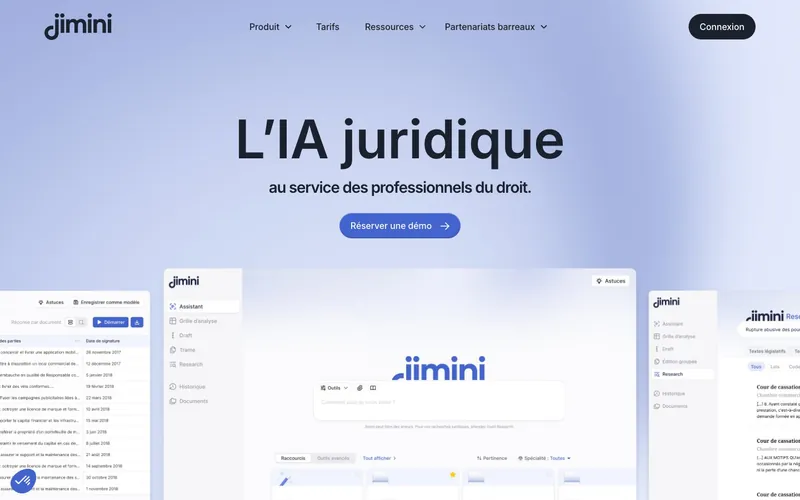
Exemplary transparency about partial sovereignty. Sovereignty 🟡 N2. On quote.
Jimini is a France 2030 laureate (“Accelerating the use of generative AI in the economy”) with a partnership with the Paris Bar (3 months free for firms of 1 to 20 lawyers), and recognition from the Bar at the Conseil d’État and Court of Cassation.
Jimini deserves separate treatment on sovereignty, because it is the most transparent publisher on the market about its chain: their documentation states in black and white that the cloud provider is Scaleway (data stored in France) and the LLM provider is OpenAI, with models deployed in Europe and a contractual non-retention commitment (Zero Data Retention) with all their LLM partners. Add ISO 27001:2022 certification, a 2025 penetration test with no exploitable vulnerability and data isolation between firms. Rule 1 therefore works fully in their favour: no downgrade, a clean and documented N2. And that is also what this N2 reveals: saying exactly where the data goes makes it possible to observe that inference leaves for OpenAI. Contractual ZDR reduces the risk, it does not change the jurisdiction. A textbook case for telling sovereign marketing apart from end-to-end sovereignty.
Strengths:
- Exemplary technical transparency, the best in this comparison
- French hosting with Scaleway, ISO 27001:2022, data isolation between firms
- First mover on the new generation of legal AI assistants, with a genuine technological lead on workflow integration (contract review, mail merge, integration with existing tools)
- Simple interface, responsive French support
Weaknesses:
- Feedback from our panel is very mixed on the quality of the legal answer: the tooling is there, the legal depth does not always follow
- No proprietary corpus, the tool relies on external sources
- OpenAI inference: N2, pseudonymised data recommended for sensitive documents
Our take: the market pioneer, technically ahead and transparent in a way that should set a precedent. But across our panel, the quality of the legal answer disappoints too often to make this an unreserved recommendation. Test it on your own use cases before committing the firm.
Haiku, formerly Clerk
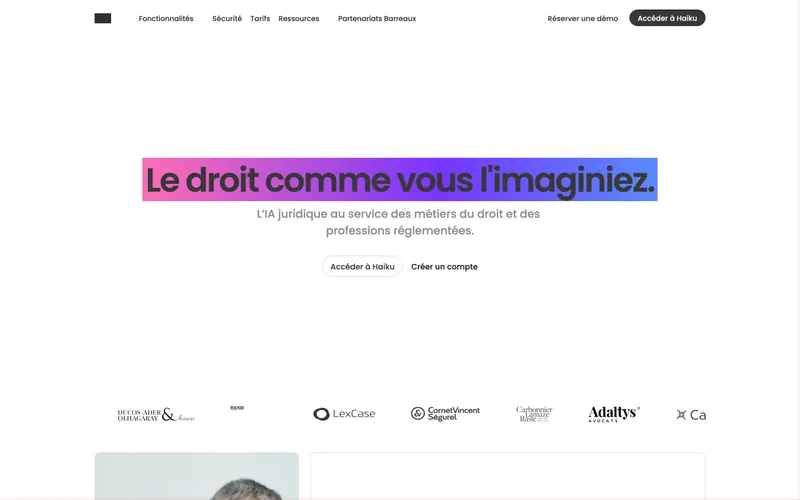
The only assistant on the market running on SecNumCloud-qualified infrastructure. Sovereignty 🟢 N1 subject to inference. On quote.
The Bordeaux startup founded in 2023 (incubated at Unitec, CEO a doctoral candidate in law) changed dimension in 2026. Haiku announced its Atlas platform in June 2026, built on an agentic architecture and hosted on the cloud offering of S3NS, the Thales and Google Cloud joint venture qualified SecNumCloud by ANSSI. That is the qualification level used to protect the French state’s most sensitive data. On models, Haiku combines models developed in-house from open source building blocks, Mistral AI models, and certain Google models for the most demanding tasks. The company has 27 staff, claims more than 6,000 users, and raised €3 million in June 2026 (round led by Newfund) after €1.4 million in 2024, with ISO 27001 certification, Septeo and Diapaz integrations, and zero reuse of data for training.
Our reservation, single but real: public documentation does not specify whether calls to Google models stay within the S3NS perimeter or leave for Google Cloud. In the first case, rule 4 applies and N1 is full; in the second, those specific tasks fall under N2. Hence the badge: N1 subject to inference.
Strengths:
- SecNumCloud-qualified infrastructure, a level of assurance no other assistant in this comparison offers
- Agentic architecture (Atlas): reusable legal skills that run complete workflows, not just a chat
- The tool works on the user firm’s own document base, with strong data segregation between clients
- Founders from the legal world, product built on user feedback
Weaknesses:
- No proprietary editorial corpus
- The execution perimeter of the Google models remains to be publicly documented
- Still limited hindsight on highly specialised uses at scale
Our take: the Bordeaux challenger has become a serious contender for the top rank. The SecNumCloud bet leaves it alone on the ground of the lawyer demanding on sovereignty without in-house technical skills, and Atlas’s agentic architecture runs with the grain of history. One more line in their public technical sheet, and the N1 badge becomes full.
Juri’Predis
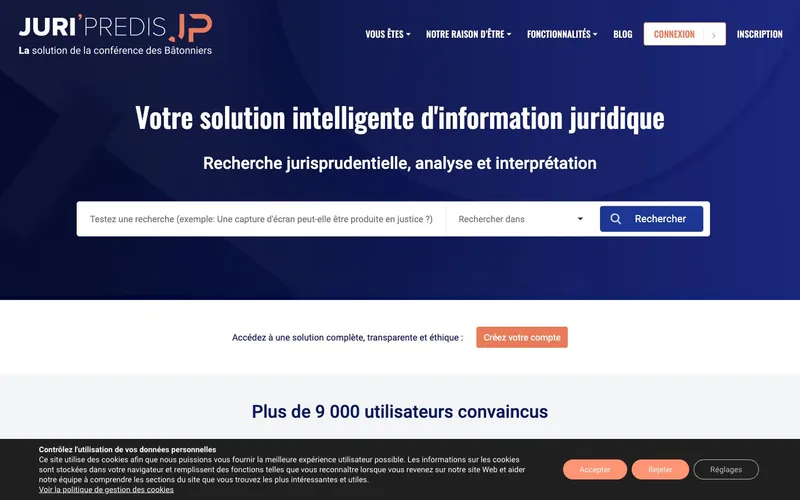
The veteran endorsed by the bars, with a model choice that runs against the grain. Sovereignty 🟡 N2 subject to hosting and inference. On quote, 15-day trial.
Nine years of experience, 33 million documents, 84 partner bars, more than 9,000 professionals. And a technical choice that sets it apart from almost the whole market: Juri’Predis chose Mistral AI’s models as its LLM, with encrypted data hosted in the European Union and a commitment not to train on user data. Where most competitors have their own hosting and an American model, Juri’Predis presents the reverse situation: European model, hosting to be proven.
Two reservations justify the badge. The host is not named in their communication (“hosted in the EU”), and a third-party source mentions DigitalOcean in the Netherlands and Germany, an American operator, which would tip storage into N3 if confirmed. And “models supplied by Mistral AI” does not say who operates inference: Mistral is consumed through La Plateforme (a French operator), but also through Azure, Bedrock or GCP, and the jurisdiction changes entirely depending on the channel.
Strengths:
- Algorithms that respect the logic of legal reasoning, designed by researchers in law and AI
- The Mistral choice: with Haiku, the only player in this comparison to claim a European model provider
- 84 partner bars, strong institutional adoption
- Generative AI is now integrated into search, alongside the original engine
Weaknesses:
- Host and inference operator not publicly named
- Less publicised than the others, limited public documentation on performance
- No annotated editorial corpus, as with all legaltechs
Our take: a solid, proven solution, often underestimated, and the only established player to have made the Mistral choice. That 84 bars trust it is a strong signal. Two lines of technical sheet (host, Mistral inference channel) and the badge could move up a level.
MCP Factory by Zevra
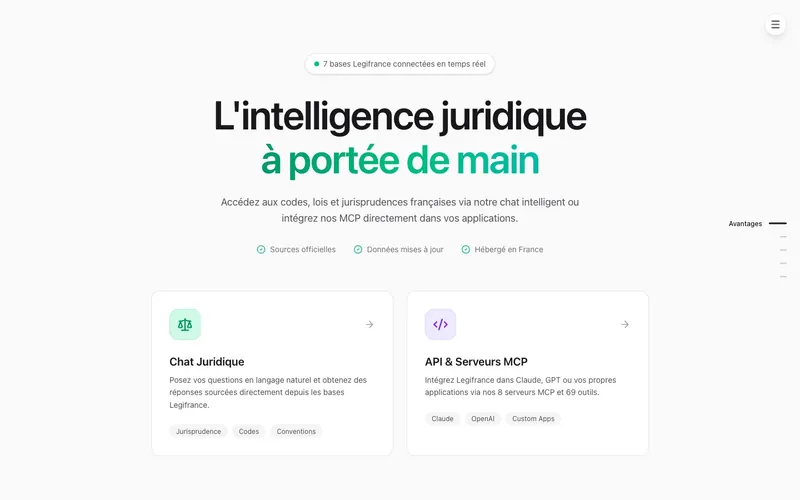
The open data infrastructure that plugs any LLM into French law. Sovereignty 🟢 N1 infrastructure, final level depends on the model plugged in. Open / API. mcp-juridique.fr
MCP Factory is an infrastructure layer that connects any LLM (Claude, GPT, Gemini, or a self-hosted model) to official French legal data through the MCP protocol (Model Context Protocol). It is currently the most complete legal MCP on the market.
Concretely:
- 19 MCP servers, 180 legal tools that can be integrated into any AI agent
- 7 Légifrance databases connected in real time (case law, codes, collective agreements)
- More than 2 million texts indexed, direct synchronisation through the French government’s PISTE APIs
- No cache, no stale data, live updates
- Built-in legal chat in addition to API access
Hosting: France, GDPR, OAuth2 and TLS, 99.9% uptime.
The sovereignty point, applied to ourselves: we apply to our own product the grid we impose on others. The MCP Factory infrastructure runs on our infrastructure in France and queries official sources live: N1 on that perimeter. But nobody can claim sovereignty on behalf of the model you plug in. Connected to Claude or GPT, your usage is N2 in practice, since your prompts transit an American provider. Connected to a self-hosted model or one operated under European jurisdiction, the whole is N1 end to end. MCP Factory is thus the only tool in this comparison where the sovereignty level is entirely in the user’s hands, and remains reversible at any time.
Our take: MCP Factory proves that a legal AI does not need premium editorial corpora to perform. You plug your model into the entirety of official French law: codes, statutes, case law, collective agreements. No annotated commentary, but for 95% of practitioner needs, that is enough. It is also the bet we defend in the final section.
Dairia IA

An employment law firm’s expertise turned into an AI assistant. Sovereignty 🟠 N3. €179/month, 7-day trial. dairia.ai
Dairia Avocats is a Lyon firm specialised in employment law for ten years, which turned its expertise into a conversational assistant: Labour Code, payroll, URSSAF, social security, with plain-language answers designed for SME executives, HR directors and accountants, downloadable template documents and escalation to a lawyer when the case exceeds the AI.
On the technical chain: the backend runs on Supabase, an American platform whose infrastructure sits on AWS. Supabase is SOC 2 Type 2 and ISO 27001 certified, but certification does not change jurisdiction: American operator, Cloud Act applicable, N3 in our grid. It is a useful methodological reminder: a security certification attests to good practice, never to extraterritorial immunity.
Strengths:
- Clear hyper-niche positioning: 100% employment law, supervised by the firm’s lawyers
- Plain-language answers for a non-lawyer audience
- Escalation to a lawyer built into the journey
Weaknesses:
- The scope/price ratio raises questions: at €179/month, the subscription costs as much as a frontier model subscription such as Claude, for a much narrower scope confined to employment law
- Supabase backend: infrastructure under US jurisdiction
- Model provider not publicly disclosed
Our take: the “augmented firm” model remains a clever idea, and the SME/HR target is well chosen. But at the current price, the value proposition is debatable against a well-equipped generalist model, and the technical chain does not allow sensitive data without prior pseudonymisation.
Legaia
The legal assistant inside your inbox. Sovereignty 🟠 N3. On request. legaia.ai
A new entry in this comparison: Legaia, founded by lawyer Jean Petreschi, closed an €800K pre-seed round in May 2026. The product bet is original: Gaia, the assistant, works entirely by email. You write to it as you would to an associate, it drafts a first version on your letterhead, searches case law (Légifrance and Pappers Justice integrations), retrieves official documents (Infogreffe, INPI), translates through DeepL Pro, converts and numbers exhibits. Zero adoption friction: no new platform to learn.
On the technical chain, Legaia’s documentation states that analysis and drafting go through an “integration with Chat GPT Pro”, and claims data “hosted in France” with GDPR compliance. But the Security & Sovereignty page in that same documentation is an image, with no host named and no retention regime detailed. Claimed hosting unverifiable, OpenAI inference, and an email channel that is itself a classic weak point for professional secrecy: N3, by application of rules 1 and 2.
Strengths:
- The simplest adoption on the market: the tool lives in the inbox, where lawyers already work
- Useful, concrete integrations (Pappers Justice, Infogreffe, INPI, DeepL Pro), included in the subscription
- Founded by a practising lawyer, designed for solos and small to mid-cap structures
Weaknesses:
- Insufficiently documented technical chain: host not named, mention of a “Chat GPT Pro” integration that deserves clarification (enterprise API or consumer subscription, the difference is major for confidentiality)
- The email channel itself: convenient, but rarely end-to-end encrypted
- Young company, limited hindsight
Our take: the idea of embracing the tool lawyers already use is the right answer to the market’s real problem, adoption. But as public documentation stands, Gaia should be reserved for tasks on public or pseudonymised data. A complete technical sheet would change the picture.
International solutions
Beyond the French market, several international players carry real weight, especially for business law firms and multi-jurisdiction structures. What they share: genuine power, but a processing chain outside the EU (🔴 N4) that reserves them for non-sensitive uses in French law.
Harvey AI
International business law firms. Sovereignty 🔴 N4 (US hosting). ~$1,000 to $1,200/month per user.
Harvey is the benchmark for large Anglo-American firms and a few CAC 40 structures. Impressive generative power, integration into firm workflows, processing of enormous document volumes. The flip side: American hosting, OpenAI-family models, hence direct exposure to the Cloud Act and common law bias to watch for in a civil law setting. The price puts it out of reach for a mid-sized French firm.
Verdict: excellent in international M&A and corporate, beside the point for a French firm concerned about sovereignty.
Lexis+ AI (LexisNexis)
The global documentary corpus, the French disappointment. Sovereignty 🔴 N4. On quote, high price.
Backed by one of the largest documentary corpora in the world, Lexis+ AI appeals on paper to international structures already using LexisNexis. On French ground, the verdict from our panel of audit clients is unambiguous: invented case law reported repeatedly, and answers regularly off-target on French law questions. That observation matches the public data: the Stanford study on legal tools with RAG measures hallucination rates of 17 to 33%, and Lexis+ AI was precisely in the tested sample. A global documentary corpus compensates for neither the weak French adaptation nor the phantom case law. Add the group dynamic: RELX is in the process of acquiring Doctrine, and both data location and the French roadmap remain to be settled.
Verdict: at the price asked and given the feedback, hard to recommend for French legal practice. Relevant only for international structures on Anglo-American uses, with systematic source verification.
Spellbook
Contract drafting inside Word. Sovereignty 🔴 N4. ~$100 to $200/month.
A Word add-in that generates and reviews clauses, with native integration into the drafting flow and fast adoption. But the tool is designed for Anglo-American law (clauses, formats) and hosting is North American.
Verdict: handy for contracts in English. For the French market, Oro/Tomorro is a better fit.
Legora (formerly Leya)
The European multi-model challenger. Sovereignty 🟠 N3. On quote.
An assistant for firms taking a multi-LLM approach, with strong traction in Northern Europe. The multi-model approach implies by construction calls to American providers, and data location for France remains to be confirmed before any use on sensitive documents.
Verdict: a player to watch in the coming months, on public or pseudonymised data pending a clear technical sheet for the French market.
Niche tools
| Tool | Speciality | Strong point | Sovereignty |
|---|---|---|---|
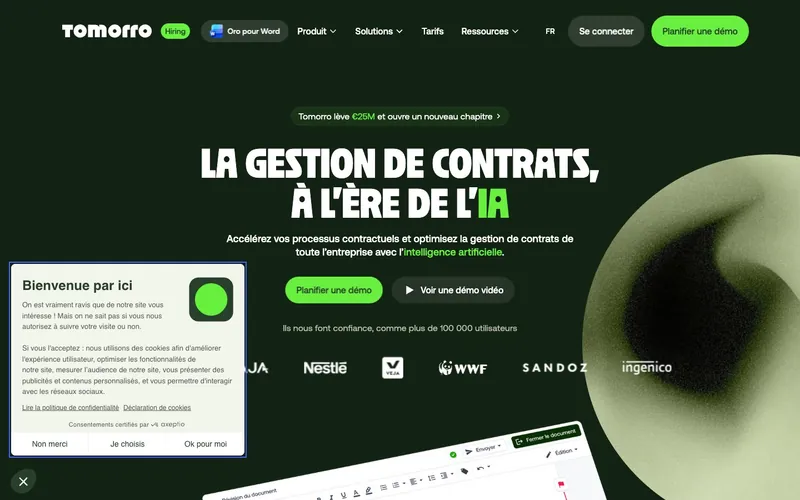
| Oro (Tomorro) | Contract drafting and management | French CLM benchmark. ISO 27001. Clients Nestlé, Clarins, Vinci. €25M round | 🟡 N2 (host to be documented) |
| Lexbase | Legal research and publishing | One of the first French legaltechs (1998), own corpus, sovereign hosting claimed | 🟡 N2 |
| Jus Mundi | International law and arbitration | Unique multilingual base, essential in international arbitration, OVH hosting | 🟡 N2 subject to inference |
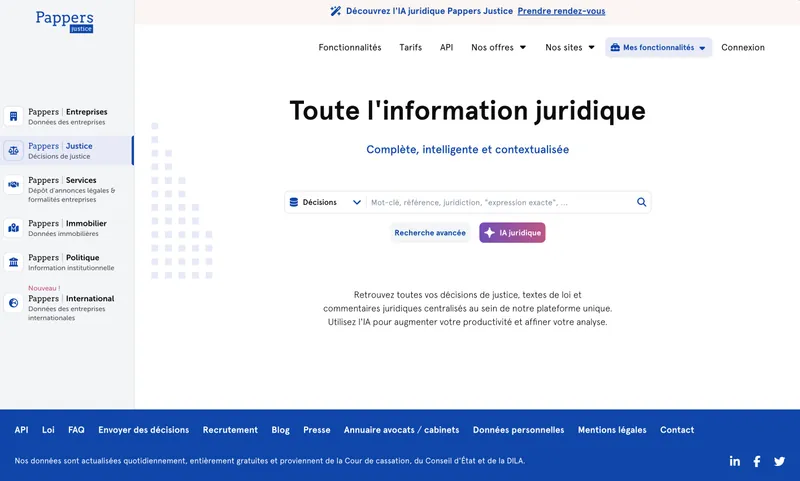
| Pappers Justice | Open data case law | 1.5M decisions freely accessible and a JSON API. The best free option | 🟡 N2 |
| Juribot | Free consumer assistant | French law, open access | 🔴 N4 (no published data: automatic downgrade, rule 1) |
| Lexform (Zevra) | Pseudonymisation before AI | The only tool that changes the sovereignty level of the others. In-house engine on OVHcloud Gravelines, zero retention, published sovereignty sheet | 🟢 N1 |
Which legal AI for which profile
Rather than a single ranking, here is a reading by profile. The right solution depends first on your practice and on the level of sovereignty you require.
| Profile | Dominant need | Main recommendation | Alternative |
|---|---|---|---|
| Solo lawyer, small firm | Research and drafting, sovereignty without an IT department | Haiku (SecNumCloud) | Ordalie (price) or MCP Factory (open data) |
| Litigation firm | Case law and procedural strategy | Juri’Predis | Doctrine + Predictice (price and RELX acquisition to weigh) |
| Business law firm, corporate | Annotated commentary and contract volumes | GenIA-L + Oro/Tomorro | LamyLia |
| In-house legal, SMEs | Contracts, compliance, day-to-day advice | Oro/Tomorro + Ordalie | GenIA-L |
| Employment law specialists | Employment corpus, payroll, URSSAF | LamyLia (employment corpus) | Dairia IA (SME advice, scope/price to weigh) |
| Arbitration, international law | Multilingual sources | Jus Mundi | Lexis+ AI (N4 caution) |
| International firm (M&A) | Anglo-American power and volume | Harvey or Legora | sovereignty caution |
| Documents covered by secrecy | Data flow controlled end to end | N1 solution only, or Lexform pseudonymisation upstream of the tool of your choice | Self-hosted model + MCP Factory |
Summary matrix
| Criterion | GenIA-L | LamyLia | Doctrine | Predictice | Ordalie | Jimini | Haiku | Juri’Predis | MCP Factory | Dairia |
|---|---|---|---|---|---|---|---|---|---|---|
| Reliability | ★★★★★ | ★★★★ | ★★★★ | ★★★★ | ★★★★ | ★★★ | ★★★★ | ★★★★ | ★★★★ | ★★★ |
| Scholarly corpus | ★★★★★ | ★★★★★ | ★★★ | ★★★ | ★★ | ★★ | ★★ | ★★★ | ✗ | ★★★ |
| Case law | ★★★★ | ★★★★ | ★★★★★ | ★★★★★ | ★★★ | ★★★ | ★★★ | ★★★★★ | ★★★★ | ★★★ |
| Sovereignty | 🟠 N3 | 🟠 N3 | 🟠 N3 | 🟠 N3 | 🟢 N1* | 🟡 N2 | 🟢 N1* | 🟡 N2* | 🟢 N1 infra | 🟠 N3 |
| Predictive | ✗ | ✗ | ✗ | ★★★★★ | ✗ | ✗ | ✗ | ✗ | ✗ | ✗ |
| Contracts | ★★★ | ★★★★ | ✗ | ✗ | ★★★ | ★★★ | ★★★ | ✗ | ✗ | ✗ |
| Price | €€€ | €€€ | €€ | €€€ | € | €€ | €€ | €€ | € | €€ |
* N1 or N2 “subject to”: see each solution’s entry for the evidence still expected.
Verdict and tier list
The right tool depends on your profile (see the matrix above) and on the level of sovereignty you require. We have separated the two axes: the tier list ranks product quality, the badge indicates sovereignty. An excellent tool can be N3, an N1 tool can be mediocre; conflating them would be sovereignty washing in either direction.
Tier S, the most complete editorial corpus:
- GenIA-L (Lefebvre group) 🟠 N3: the combination of a century-old editorial corpus and a mature AI layer makes it the qualitative benchmark for French law. To be fed public or pseudonymised data.
Tier A, excellent in their field:
- Haiku 🟢 N1*: the rising assistant, alone on the SecNumCloud ground, convincing agentic architecture
- Doctrine + Predictice 🟠 N3: massive case-law corpus and unique predictive analytics, but a price/technology ratio and an ownership trajectory to weigh before signing
- LamyLia 🟠 N3: solid on case law, business law and the employment corpus
Tier B, best value for money:
- Ordalie 🟢 N1*: the most interesting price/quality ratio in the sovereign segment, with a drift toward SMEs to watch
- Juri’Predis 🟡 N2*: the quiet veteran, 84 partner bars, and the Mistral choice
- MCP Factory 🟢 N1 infra: the most complete open data infrastructure (19 servers, 180 tools), at the sovereignty level you choose
- Pappers Justice 🟡 N2: the best free option for case law
Tier C, to assess case by case:
- Jimini 🟡 N2: exemplary transparency and a product lead, but mixed feedback on the quality of the legal answer
- Oro/Tomorro 🟡 N2: the French benchmark for contracts
- Legaia 🟠 N3: the simplest adoption on the market, technical chain to document
- Dairia IA 🟠 N3: clever augmented firm, scope/price to weigh
International, sovereignty caution:
- Harvey 🔴 N4: powerful, reserved for international M&A uses
- Legora 🟠 N3: to watch, French data location to confirm
- Spellbook 🔴 N4: Anglo-American contracts only
- Lexis+ AI 🔴 N4: hard to recommend for French law given our panel’s feedback
Outside the categories:
- Lexform 🟢 N1: the third route, which changes the usable level of all the others
- Juribot 🔴 N4: no public documentation, to be avoided for any client data
The hallucination problem
The main risk with a legal AI remains hallucinations. Generalist LLMs hallucinate between 69% and 88% of the time on legal queries (GPT-3.5: 69%, PaLM 2: 72%, Llama 2: 88%). Even with RAG, specialised tools keep a hallucination rate of 17% to 33% according to the Stanford study, which notably included Lexis+ AI. GenIA-L comes out at 92 to 93% satisfaction. Ordalie claims under 1% hallucination, a self-reported figure not independently verified. Our own audits confirm the trend: invented case law remains the number one reason for distrust reported by firms, across all tools.
The CNB has published a 12-criterion self-assessment grid (security, ethics, legal quality) to help you choose.
The professional conduct point: a low hallucination rate never removes the need to verify sources. It lowers the cost of doing so, not the necessity. Whatever the tool, the lawyer remains responsible for the content they produce. Human supervision is not an optional best practice, it is an obligation.
The AI Act and legal AI in 2026
The European regulation on artificial intelligence (AI Act, Regulation EU 2024/1689) is entering into application in stages. For firms, the essentials:
- Everything depends on the use case. A document research assistant and a tool assisting judicial decisions do not fall into the same risk category. The more a use touches a decision affecting a person’s rights, the heavier the obligations.
- Transparency becomes something you can demand. You are entitled to ask a publisher for clear information on the model used, the inference operator, the origin of training data and the location of hosting. That is precisely what our sovereignty grid measures, rule 1 included.
- Cumulative compliance. GDPR, professional secrecy and the AI Act stack. Data sovereignty has left the marketing arena for the compliance one.
Application deadlines run from 2025 to 2027 depending on the obligation. Check the calendar applicable to your use case before any firm-wide deployment.
Outlook at 1, 3 and 5 years
- At 1 year: the predicted consolidation has become reality: Predictice under Doctrine, Doctrine heading to RELX, Lamy under Karnov since 2022. The French independents (Ordalie, Haiku, Jimini, Juri’Predis) become the only holders of an offer under national ownership, and obvious targets. Entry prices fall, the sovereignty question rises.
- At 3 years: open data (Judilibre, Légifrance, near-complete administrative open data) makes raw research almost free. Value migrates to annotated commentary and to specialised agents connected to official data (MCP logic). The structural advantage will go to whoever controls the data infrastructure.
- At 5 years: autonomous but supervised legal agents, integrated into the firm’s workflow. The question will no longer be “which AI” but “which data architecture and which level of sovereignty”.
This trajectory reinforces one conviction: the future belongs to open data plus engineering, not to closed corpora alone.
FAQ
What is the best legal AI in France in 2026? It depends on which axis matters to you. On quality and corpus, GenIA-L (Lefebvre group) comes first, with an N3 badge that requires pseudonymising sensitive data. On sovereignty, Haiku (SecNumCloud) stands alone. On price, Ordalie. See our profile matrix.
Which legal AI for a solo lawyer on a small budget? Ordalie (PRO from €69/month, free plan to test) offers the best price compromise. For sovereignty without technical skills, Haiku. For a free and flexible approach, MCP Factory plugs your LLM into French legal open data.
Is a legal AI compatible with professional secrecy? Yes, under three alternative conditions: a genuinely N1 tool (rare: demand the technical sheet naming host, model and inference operator), a self-hosted model, or systematic pseudonymisation of documents before sending (such as Lexform). A bare “hosted in France” claim is not enough: the CNB itself judges it neither sufficient nor verifiable.
Do legal AIs still hallucinate? Yes, but far less than generalist LLMs. Specialised tools with RAG come down to 17 to 33% according to the Stanford study, and the best publishers claim more than 90% reliability. Source verification by the lawyer remains indispensable.
Should a French sovereign AI be preferred to Harvey or Lexis+ AI? For a French firm handling sensitive client data, yes, and the Lexis+ AI case adds a quality argument: our panel’s feedback on French law is poor, invented case law included. Harvey retains its interest for international structures on non-sensitive Anglo-American uses.
How much does a legal AI cost? From free (open data, Pappers Justice, Ordalie’s free plan) to more than $1,000/month (Harvey). The core of the French market sits between €70 and €250/month per user. Traditional publishers often work on quote, with query quotas to check before signing.
Are ChatGPT or Claude enough for law? For brainstorming or rephrasing, yes. To produce reliable, sourced law, no: these generalist models hallucinate heavily on legal queries and offer no sovereignty guarantee in their consumer versions. Two complements change the equation: plugging them into official sources (MCP Factory) and pseudonymising data upstream (Lexform).
What does legal open data actually change? It makes case law (Judilibre, administrative justice) and legislation (Légifrance) free and accessible. Good RAG on those sources covers around 95% of practitioner needs. See our dedicated section.
Does the AI Act impose obligations on firms? Yes, proportionate to the use case. The essentials: demand transparency from the publisher and document the sovereignty level of the tool used.
How do you assess a legal AI objectively? Use the CNB’s 12-criterion self-assessment grid (security, ethics, legal quality) and cross it with our five-level sovereignty grid, demanding evidence link by link.
Why open data is the future of legal AI
A proprietary documentary corpus matters for the quality of the output, but today open source and the available APIs already deliver exceptional results and cover 95% of practitioner needs.
Free legal data available in France
| Source | Content | Access |
|---|---|---|
| Judilibre API (Court of Cassation) | Around 480,000 decisions pseudonymised since 1947 | Free through PISTE |
| Administrative justice open data | All decisions of the 42 administrative courts, 9 appeal courts and the Conseil d’État | Free |
| ArianeWeb (Conseil d’État) | More than 270,000 decisions with analysis and the public rapporteur’s conclusions | Free |
| Légifrance / DILA API | 73 codes in force consolidated and 29 repealed, statutes, ordinances, decrees | Free through PISTE |
| Pappers Justice | 1.5 million decisions and a structured JSON API with enriched metadata | Free (and premium) |
France issues around 3.9 million decisions per year. The regulatory calendar provided that by the end of 2025 nearly all judicial and administrative decisions would be in open data. It is the law (article L111-13 of the Code of Judicial Organisation), from the 2016 Digital Republic Act.
What open data covers
- Finding the applicable statutory provision: Légifrance API, free, consolidated, up to date
- Finding relevant case law: Judilibre, Pappers Justice and administrative open data
- Checking the state of positive law: Légifrance is the Official Journal
- Drafting a standard document: prompts on positive law sourced from open data give excellent results
- Preparing a hearing: the case law of the relevant court is available in open data
Well-built RAG on Judilibre, Légifrance and Pappers, with a good LLM behind it, already delivers very high quality without an editorial subscription.
The 5% open data does not cover
| Gap | What it represents | Who provides it |
|---|---|---|
| Annotated commentary | Article annotations by professors and practitioners, case notes | Dalloz, Lamy, Lexbase, LextenSo |
| Annotated codes | An article with 15 years of case law sorted and commented by a specialist | Dalloz, Lamy |
| Editorial curation | Ranking the importance of a decision (reported in the Bulletin or unreported) | Traditional publishers |
| Specialised journals | JCP, Recueil Dalloz, AJDA, RDC, the living scholarly debate | Publishers exclusively |
As a Cairn study notes, open data has forced publishers to concentrate on their real added value: editorial engineering. The real question for a firm today: do my 5% of complex cases justify a premium editorial subscription, or can I manage with an open data solution plus an occasional consultation when I need one?
For many firms, the most relevant solution covers their actual needs at a fair price, regardless of how well known it is.
Our testing methodology
1. Real-world testing. Each solution was tested on concrete use cases from our own practice: case-law research (employment law, contract law, criminal law), clause drafting, decision analysis, compliance checks.
2. Evaluation criteria. Seven criteria: reliability of answers (manual source verification), breadth of corpus, quality of sourcing, data sovereignty, usability, value for money, relevance for a general practitioner.
3. Sovereignty chain verification. New in this edition: for each solution, we sought to document the hosting provider, the model provider and the inference operator, based on publishers’ public technical sheets, their documentation and the trade press. Where no public evidence exists, rule 1 of our grid applies: downgrade by one level. The “subject to” mentions flag the evidence still expected.
4. Institutional cross-checking. Our results were compared against the CNB’s assessments (12 solutions, March 2025), its self-assessment grid and the independent comparisons by Meta-Doctrinal, Pamplemousse Magazine and Le Barreaumètre.
5. Hallucination benchmarks. Data from published, verifiable research: the Stanford/Yale study and IA Focus Magazine’s analysis.
6. Prices. Compiled from our directory of 184 legaltechs and verified on publishers’ websites in August 2026. “On quote” pricing depends on the number of users, and query quotas should be checked before signing.
7. Independence. No affiliate links. No solution paid us or gave us privileged access in exchange for a favourable review. We publish MCP Factory and Lexform, and we apply the same grid to them as to everyone else, reservations included.
This article is updated regularly. Last revision: August 2026. Full individual tests of each solution will be published progressively.
Further reading: Data sovereignty: definition and stakes for lawyers, AI hallucinations: definition, mechanisms and solutions, Legal RAG: the complete guide and our legaltech directory.
Sources
- RELX Group enters into agreement to acquire Doctrine (press release, April 2026)
- Lamy Liaisons, acquired by Karnov Group (2022)
- Karnov Group, completion of the Wolters Kluwer France acquisition
- Lefebvre Dalloz: choice of OpenAI LLMs for GenIA-L (L’Usine Digitale)
- GenIA-L awarded by OpenAI (Lefebvre Dalloz)
- Dalloz AI / GenIA-L review (JusticeIA)
- 2026 guide, which legal AI to choose (Meta-Doctrinal)
- Legal AI for lawyers, comparison (Le Barreaumètre)
- Legal AI 2026, full comparison (Pamplemousse Magazine)
- Ordalie, €1.8M round (Frenchweb)
- Ordalie, official site
- Ordalie AI review (JusticeIA)
- Jimini AI, firm guide (technical chain Scaleway + OpenAI)
- Jimini AI, guarantees and compliance (help centre)
- France 2030 selects Jimini AI (Le Monde du Droit)
- Paris Bar x Jimini partnership
- Haiku builds on S3NS (L’Usine Digitale, June 2026)
- Haiku raises €3M (La Revue du Digital)
- Juri’Predis: choice of Mistral AI models (Village de la Justice)
- Juri’Predis, official site
- Legaia, €800K pre-seed round (Le Monde du Droit)
- Legaia, documentation
- MCP Factory, Zevra
- Dairia IA
- Supabase, security and certifications
- Lexform / lexform.zevra.tech, sovereignty sheet
- Legal AI and hallucinations (IA Focus Magazine)
- Legal hallucinations, Stanford study (ActuIA)
- CNB, legal AI evaluation grid
- March 2025 AI survey, CNB / Viavoice
- Paris Bar AI offers
- LamyLia, Lamy Liaisons
- Tomorro / Oro
- Pappers Justice
- Judilibre API (data.gouv.fr)
- Administrative justice open data
- Légifrance / DILA API
- AI Act, Regulation EU 2024/1689
- Digital Republic Act, legal framework (Predictice)
- Open data and legal publishers (Cairn)