Maîtrisez l'IA

Change language

I have a tech project!
Free track · 9 capsules · Zevra Campus

AI for Lawyers, the fundamentals.

You tried ChatGPT and got nothing out of it ? That's normal. This track takes everything back from the start. This time, with method.

9

Video capsules

4–6 h

At your own pace

€0

No credit card

62%

Of lawyers use AI

Generative artificial intelligence does not work like a search engine, does not write your submissions for you, and will replace neither your professional ethics nor your judgment. It's a powerful tool, misunderstood by most legal professionals, and mastering it rests on precise skills no one ever taught you : not at university, not at bar school, not at the firm.

62% of French lawyers report using generative AI (CNB survey, 2024). How many can explain the difference between an LLM and a semantic search engine ? How many know the settings that change the quality of an output ? How many have a structured method for writing a prompt that produces a result usable in legal practice ?

"The AI Fundamentals" is an e-learning track of 9 capsules designed for lawyers and legal professionals who want to understand what they're using. And above all, learn to use it properly. The track is free, no credit card, accessible with a Rookies account on Zevra Campus.

In your Campus space

A learning experience built for legal professionals

HD videos, interactive exercises, free navigation between steps, bookmarks, questions to the community. Everything is framed so you never get lost.

campus.zevra.tech / parcours / fondamentaux-ia ● live
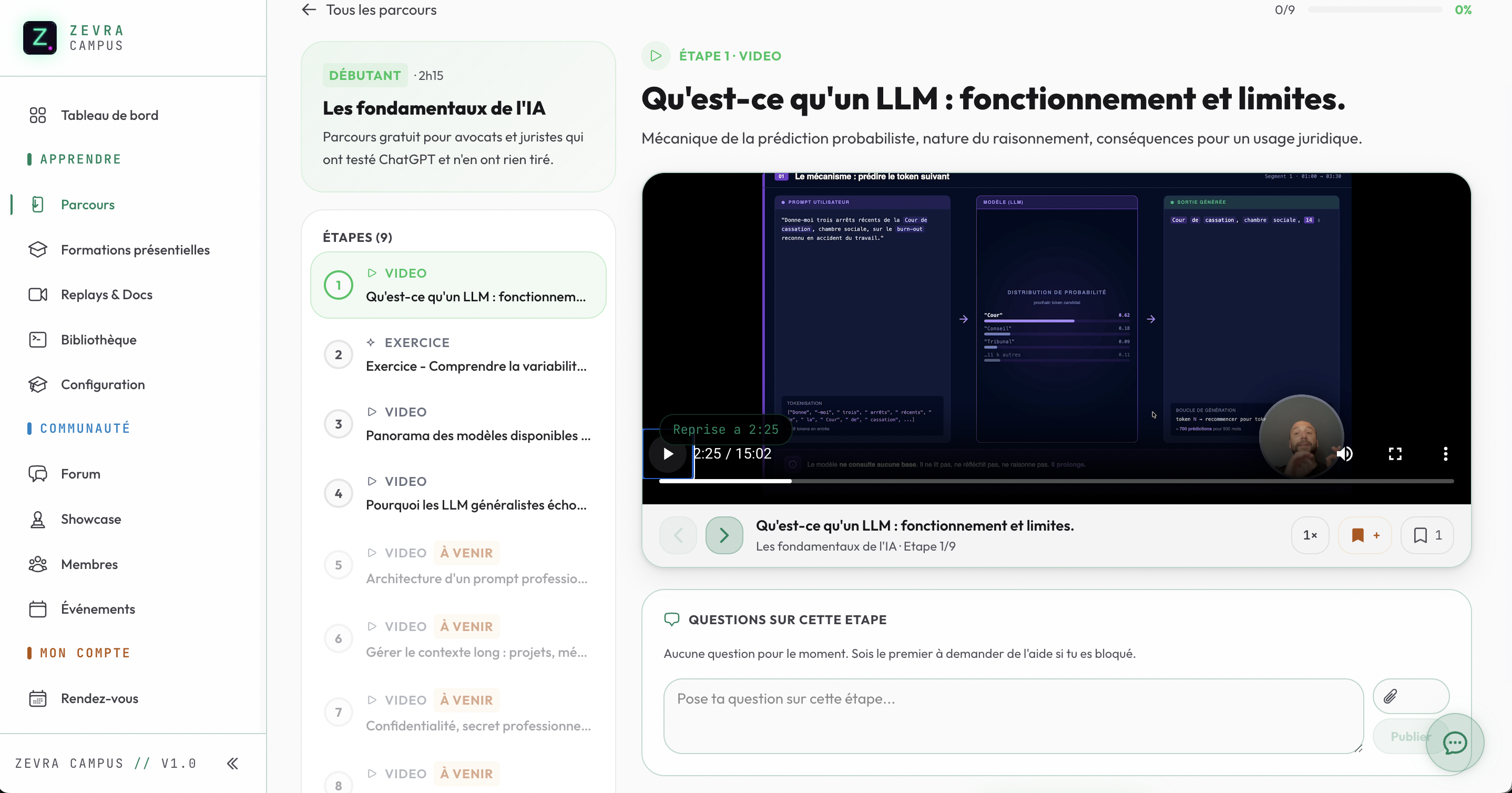
Preview of the "The AI Fundamentals" track in the Zevra Campus space: navigation sidebar, list of the 9 steps, video player with the current capsule.

A real preview of the track in the Campus space, accessible with a Rookies account.

The track in 9 steps

What you'll learn

Each capsule stands on its own. Watch them in order, or pick what you need.

01
Theory

What is an LLM : how it works and its limits

It all starts here. An LLM does not work like a database: it's a statistical model that predicts the most probable continuation of a text. That distinction changes everything. It explains why ChatGPT, Claude or Gemini can produce elegant legal reasoning built on case law that does not exist.

On the agenda : the machine learning behind generative models, the notion of tokens, the context window, and the mechanical reason behind hallucinations. No useless jargon. Explanations designed for lawyers.


02
Exercise

Exercise : understanding an LLM's variability

Theory without practice is worthless.

This exercise puts you face to face with a phenomenon every AI user notices without understanding it : ask an LLM the same question twice and you get two different answers. Why ? What does it imply for a lawyer using AI in a brief ? How do you stabilize the results ? You experiment, you observe, you understand.

03
Theory

Overview of the models available in 2026

ChatGPT was never the only model. And depending on the use case, it's rarely the best.

A map of the LLMs available to legal professionals today : GPT (OpenAI), Claude (Anthropic), Gemini (Google), Mistral (Mistral AI), Copilot (Microsoft), GenIA-L (Lefebvre Dalloz). For each model : the strengths, the weaknesses, the price, and the use cases where it excels in a legal context.

The capsule also covers the critical distinction between consumer offerings (free, with no confidentiality guarantee) and professional offerings (API, Enterprise plans, European hosting). A central point for upholding professional secrecy and GDPR compliance.

04
Theory

Why general-purpose LLMs fail at legal reasoning

The capsule that shifts your perspective.

A general-purpose LLM has been trained on the entire web. It knows a little about everything. But legal reasoning has specific features these models do not naturally master : the structured argument, the distinction between facts and law, reasoning by case-law analogy, the hierarchy of norms.

When you ask ChatGPT to draft submissions, it produces something that looks like law. It isn't always. This capsule explains why, and above all how to work around these limits : structured prompts, injecting legal context, forced reasoning chains, source verification.

05
Practice

The architecture of a professional prompt

Prompt engineering separates the lawyer who "tests" ChatGPT from the one who builds it into their daily workflows.

A professional legal prompt rests on an architecture : role, factual context, precise instruction, output format, ethical constraints. This capsule breaks down each element with examples : case-law research, drafting memos, contract analysis, summarizing documents, preparing client meetings.

You leave with reusable prompt templates for your day-to-day practice.

06
Practice

Managing long context : projects, memory, files

An LLM remembers nothing between two conversations. Its context window is limited. And when you feed it an 80-page legal document, it doesn't "read" it the way you do.

These technical constraints have direct consequences for practice. How do you submit a large file to a model ? How do you structure a project across several sessions ? How do you use persistent memory, attached files, system instructions ? You turn your use of AI from an occasional tool into a structured work assistant.

07
Professional ethics

Confidentiality, professional secrecy and GDPR

The capsule every lawyer should watch first.

Is the data you enter into an LLM used to train the model ? Where is it stored ? For how long ? ChatGPT Free, Claude Free and Gemini Free do not offer the same guarantees as professional offerings. And not all professional offerings are equal.

The privacy policies of the main providers, the contractual guarantees to demand, the GDPR framework, sub-processing clauses, data location. The capsule incorporates the CNB's AI tool selection guide (June 2025) and the AI clause in standard fee agreements (April 2026).

08
Practice

The settings that change output quality

Most lawyers use AI with the default settings. It's like driving a car without ever shifting gears.

Temperature, top-p, maximum length, system instructions, stop sequences : these settings directly influence the quality, creativity and reliability of the answers. A low temperature produces deterministic answers (legal research). A high temperature produces creative answers (strategic brainstorming). The optimal setting depends on the task.

This capsule makes these settings accessible to non-technical users and shows their concrete impact on legal use cases.

09
Practical case

Summarizing a large case file : method and practical case

The closing capsule is a complete practical case.

You take a large legal file (an expert report, a bundle of exhibits, a set of contracts) and apply every skill you've acquired : model selection, prompt structuring, long-context management, settings, verification, confidentiality.

The goal : to produce a usable summary, the kind of deliverable you could send to a client or use in an internal memo. While measuring the time saved compared with your usual method.

Who it's for

The right track for you ?

Lawyers & legal professionals

You've tried AI without a method and want to start over from the beginning. No technical background needed. A few hours to understand a tool that will shape legal practice for the next ten years.

Legal departments

A shared training foundation for your teams. A common reference before rolling out AI tools in-house.

Trainee lawyers

Your school offers no structured AI module ? That's the case in 9 out of 11 French bar schools. Read the full study.

Format & access

How it works

  • 9 capsules : 8 videos + 1 hands-on exercise.
  • Free pace : each capsule can be watched independently, at your own tempo.
  • Estimated duration : 4 to 6 hours in total.
  • Access : free with a Rookies account on Zevra Campus. No credit card.
  • Prerequisites : none. Having tried ChatGPT at least once is a plus, not a requirement.
Create my Rookies account (free)
Témoignages

Ils en parlent mieux que nous

Des Avocats et juristes qui sont passés par nos formations. Pas de filtre, pas de réécriture, leurs mots à eux.

100 % de nos apprenants sont satisfaits

Évaluations post-formation

Vos formateurs

Les visages derrière les formations

Nos formateurs construisent des outils IA juridiques tous les jours pour de vrais cabinets. Vous êtes formé par celles et ceux qui pratiquent.

Pierre Colliot
Pierre Colliot

Président · Chief AI Officer

11 ans d'innovation dans le secteur juridique. Fondateur de La Fabrique Juridique, créateur de Supernovia.io, ex-Directeur Marketing Jarvis Legal. A accompagné des dizaines de cabinets et legaltechs dans leur croissance.

Alexis Deborde

Alexis Deborde

Co-fondateur

Juriste devenu entrepreneur, pionnier de la legaltech française. Fondateur de Leganov, co-fondateur d'Hercule, créateur de Smartpreuve. Classé parmi les « 40 qui font le futur du droit » par l'Institut Choiseul.

Joachim Darmalingon

Joachim Darmalingon

CTO

7 ans en développement d'applications SaaS. Ex-développeur Legal Pilot, Lead Dev Supernovia.io, créateur de Lexiwork et KaribNav. Ingénieur MIAGE, spécialiste des architectures scalables.

Benjamin Barbé

Benjamin Barbé

Infra & Cybersécurité

Tech Lead et Solution Architect, fondateur de Techspike, créateur de la Zevra Factory. Spécialiste des migrations complexes, architectures distribuées et cybersécurité juridique (RGPD/NIS2, ANSSI).

Gilles Monnier

Gilles Monnier

Chef de Projet IT

Le chef d'orchestre qui transforme la vision en livraison. Il assure le lien entre les exigences métier des clients et l'exécution technique. Respect des délais, conformité, intégration.

Pierre-Louis Roquet

Pierre-Louis Roquet

Avocat · Animateur Campus

Avocat au barreau de Lyon, co-fondateur de SmartLawyer. Anime la communauté Zevra Campus et intervient sur les formations Avocats. Un Avocat qui forme des Avocats.

What's next ?

Three more tracks already available

The "AI Fundamentals" track lays the groundwork. The rest builds on it.

Shall we start with the fundamentals ?

A few hours to understand what you use every day. No credit card, no commitment. You decide afterwards whether you want to go further.

This track is part of the Zevra Campus offer, an ongoing AI training platform for legal professionals.